蜍 (chú) means "Toad" in Chinese. It has 13 strokes with the radical 虫.
Rated 4.2/5 in difficulty (advanced).
Appears in 3+ common words including 蟾蜍 (chán chú), 蟾蜍皮 (chán chú pí), 蟾蜍鸣 (chán chú míng).
Due to its 13 strokes, Hanzi Writer's error detection shows 蜍 requires focused practice — most learners need 10+ attempts for consistent accuracy.
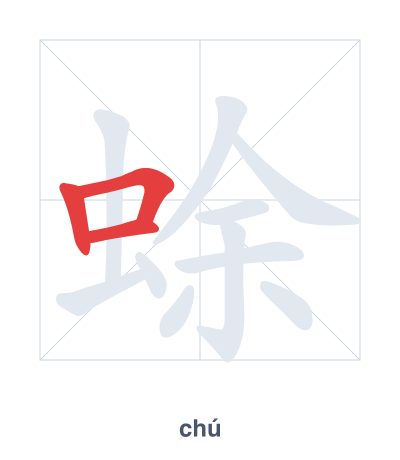
Open Hanzi Writer to see the animated stroke order and practice writing 蜍 with real-time feedback.
The character 蜍 (chú) is written with 13 strokes. Follow the standard Chinese stroke order: top to bottom, left to right, outside before inside. The radical 虫 is one of its key components.
Practice the correct stroke order with the Hanzi Writer app to see animated stroke-by-stroke guidance with real-time feedback.
蜍 means Toad.
蜍 is a semantic-phonetic compound. The radical 虫 (insect/creature) indicates it is an animal, while 余 (yú, surplus) provides the phonetic component (with a sound shift to chú). Together they form the character for 'toad,' a creature often associated with damp, leftover places.
💡 Memory Tip: Picture a toad (虫) with a big, leftover (余) belly hopping away from a pile of spare food.
蟾蜍在池塘边。
chán chú zài chí táng biān
The toad is by the pond.
蟾蜍皮很粗糙。
chán chú pí hěn cū cāo
Toad skin is very rough.
听,蟾蜍在叫。
tīng chán chú zài jiào
Listen, the toads are croaking.
Open Hanzi Writer to see the animated stroke order and practice writing 蜍 with real-time feedback.
✨ Animated stroke order · Handwriting recognition · HSK-graded practice · Free to use
The character 蜍 is composed of the radical 虫 (insect or creature) on the left, indicating it is an animal, and the component 余 on the right, which mainly provides a pronunciation clue. The radical 虫 directly connects to the meaning "toad," since toads are small animals. The right side 余 does not contribute to the meaning but helps with the sound of chú.