徜 (cháng) means "To wander (bound morpheme)." in Chinese. It has 11 strokes with the radical 彳.
Rated 4.2/5 in difficulty (advanced).
Appears in 3+ common words including 徜徉 (cháng yáng), 徜徉其间 (cháng yáng qí jiān), 徜徉自得 (cháng yáng zì dé).
Due to its 11 strokes, Hanzi Writer's error detection shows 徜 requires focused practice — most learners need 10+ attempts for consistent accuracy.
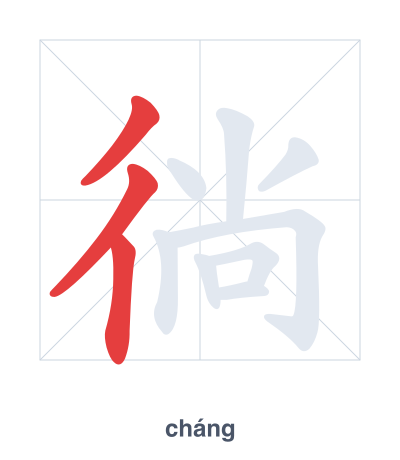
Open Hanzi Writer to see the animated stroke order and practice writing 徜 with real-time feedback.
The character 徜 (cháng) is written with 11 strokes. Follow the standard Chinese stroke order: top to bottom, left to right, outside before inside. The radical 彳 is one of its key components.
Practice the correct stroke order with the Hanzi Writer app to see animated stroke-by-stroke guidance with real-time feedback.
徜 means To wander (bound morpheme)..
徜 is a compound character with the radical 彳 (step or walk) on the left and 尚 (shàng, meaning 'still' or 'yet') on the right as a phonetic component. The radical indicates movement, while 尚 gives the sound, together forming the idea of wandering or strolling leisurely.
💡 Memory Tip: Imagine a person (彳) strolling aimlessly under a tall sun (尚), still wandering without a destination.
徜徉在书海中。
cháng yáng zài shū hǎi zhōng
To immerse oneself in a sea of books.
游客徜徉其间。
yóu kè cháng yáng qí jiān
Tourists are strolling through it.
他在草地上徜徉。
tā zài cǎo dì shàng cháng yáng
He is strolling on the grass.
Open Hanzi Writer to see the animated stroke order and practice writing 徜 with real-time feedback.
✨ Animated stroke order · Handwriting recognition · HSK-graded practice · Free to use
The left part is the radical 彳 (chì), meaning "step" or "walk," which hints at movement. The right part is 尚 (shàng), which originally meant "still" or "yet" but here gives a sound clue while also suggesting a relaxed pace. Together, 徜 conveys the idea of wandering or strolling slowly.