徉 (yáng) means "To wander / hover" in Chinese. It has 9 strokes with the radical 彳.
Rated 4/5 in difficulty (challenging).
Appears in 3+ common words including 徜徉 (cháng yáng), 徘徉 (pái yáng), 徜徉自得 (cháng yáng zì dé).
Due to its 9 strokes, Hanzi Writer's error detection shows 徉 requires focused practice — most learners need 10+ attempts for consistent accuracy.
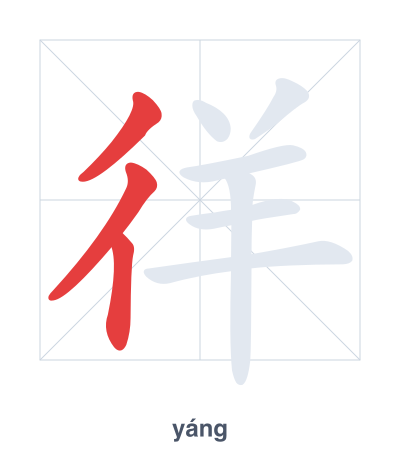
Open Hanzi Writer to see the animated stroke order and practice writing 徉 with real-time feedback.
The character 徉 (yáng) is written with 9 strokes. Follow the standard Chinese stroke order: top to bottom, left to right, outside before inside. The radical 彳 is one of its key components.
Practice the correct stroke order with the Hanzi Writer app to see animated stroke-by-stroke guidance with real-time feedback.
徉 means To wander / hover.
The character 徉 combines the radical 彳 (a step or walking) with 羊 (sheep), suggesting a leisurely, wandering movement like a sheep ambling. It originally described a slow, meandering gait, hence the meaning 'to wander or hover.'
💡 Memory Tip: Imagine a sheep (羊) taking a slow, aimless walk (彳) across a meadow, wandering wherever it pleases.
他在公园里徜徉。
tā zài gōng yuán lǐ cháng yáng
He is wandering in the park.
他在门口徘徉。
tā zài mén kǒu pái yáng
He is pacing around the door.
他在林中徜徉自得。
tā zài lín zhōng cháng yáng zì dé
He is wandering leisurely in the woods.
Open Hanzi Writer to see the animated stroke order and practice writing 徉 with real-time feedback.
✨ Animated stroke order · Handwriting recognition · HSK-graded practice · Free to use
The character 徉 has the radical 彳 (meaning "step" or "small step") on the left, which indicates movement or walking. The right part is 羊 (yáng, meaning "sheep"), which provides the sound. Together, they suggest the idea of wandering or strolling, like a sheep moving slowly.