碴 (chá) means "Fragment / Shard / Crack" in Chinese. It has 14 strokes with the radical 石.
Rated 4.2/5 in difficulty (advanced).
Appears in 3+ common words including 玻璃碴 (bō lí chá), 找碴 (zhǎo chá), 碴儿 (chá ér).
Due to its 14 strokes, Hanzi Writer's error detection shows 碴 requires focused practice — most learners need 10+ attempts for consistent accuracy.
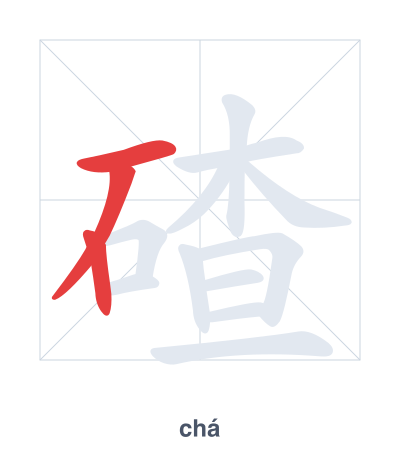
Open Hanzi Writer to see the animated stroke order and practice writing 碴 with real-time feedback.
The character 碴 (chá) is written with 14 strokes. Follow the standard Chinese stroke order: top to bottom, left to right, outside before inside. The radical 石 is one of its key components.
Practice the correct stroke order with the Hanzi Writer app to see animated stroke-by-stroke guidance with real-time feedback.
碴 means Fragment / Shard / Crack.
碴 is a phono-semantic compound: the radical 石 (stone) indicates it relates to rock or hard materials, while 查 (chá) provides the pronunciation and subtly hints at 'checking' for cracks or broken pieces. Together, they evoke the image of a stone fragment or shard that results from examining a cracked surface.
💡 Memory Tip: Imagine a stone (石) cracking with a loud 'CHA!' sound, leaving a sharp shard that you then inspect (查) for damage.
地上有玻璃碴。
dì shàng yǒu bō lí chá
There are glass fragments on the ground.
他总是故意找碴。
tā zǒng shì gù yì zhǎo chá
He is always looking for trouble on purpose.
碗上有一个碴儿。
wǎn shàng yǒu yí gè chá ér
There is a chip or crack on the bowl.
Open Hanzi Writer to see the animated stroke order and practice writing 碴 with real-time feedback.
✨ Animated stroke order · Handwriting recognition · HSK-graded practice · Free to use
The character 碴 is made of two parts: the radical 石 (meaning 'stone') on the left, and 查 (meaning 'to check' or 'to examine') on the right. The stone radical suggests hard, brittle material like glass or rock, and the right part gives the pronunciation chá. Together, they create the idea of a piece or fragment that comes from something hard, like a shard of glass.