硪 (wò) means "rammer (stone tool for tamping earth)" in Chinese. It has 12 strokes with the radical 石.
Rated 4.2/5 in difficulty (advanced).
Appears in 3+ common words including 打硪 (dǎ wò), 石硪 (shí wò), 硪歌 (wò gē).
Due to its 12 strokes, Hanzi Writer's error detection shows 硪 requires focused practice — most learners need 10+ attempts for consistent accuracy.
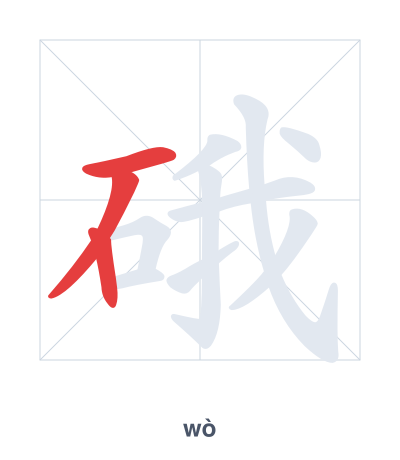
Open Hanzi Writer to see the animated stroke order and practice writing 硪 with real-time feedback.
The character 硪 (wò) is written with 12 strokes. Follow the standard Chinese stroke order: top to bottom, left to right, outside before inside. The radical 石 is one of its key components.
Practice the correct stroke order with the Hanzi Writer app to see animated stroke-by-stroke guidance with real-time feedback.
硪 means rammer (stone tool for tamping earth).
硪 is a compound character with the radical 石 (stone) indicating its material, and 我 (wǒ) providing phonetic approximation. It refers to a heavy stone tool used for tamping earth, like a rammer.
💡 Memory Tip: Picture me (我) lifting a big stone (石) and slamming it down to tamp the ground—I am the rammer!
大家一起打硪。
dà jiā yì qǐ dǎ wò
Everyone worked together to ram the earth.
这个石硪很重。
zhè ge shí wò hěn zhòng
This stone rammer is very heavy.
听,那是硪歌。
tīng nà shì wò gē
Listen, that is the rammer song.
Open Hanzi Writer to see the animated stroke order and practice writing 硪 with real-time feedback.
✨ Animated stroke order · Handwriting recognition · HSK-graded practice · Free to use
硪 is a left-right character. The left part is 石 (stone), which hints that the object is made of stone. The right part is 我 (wǒ, meaning "I" or "self"), but here it only provides the sound wò; together, 硪 means a stone tool used for ramming earth.