伧 (cāng/chen) means "Vulgar or lowly." in Chinese. It has 6 strokes with the radical 亻.
Rated 2.9/5 in difficulty (moderate).
Appears in 3+ common words including 伧俗 (cāng sú), 伧夫 (cāng fū), 寒伧 (hán chen).
Hanzi Writer's stroke validation shows learners typically need 5-8 attempts to write 伧 with correct proportion and order.
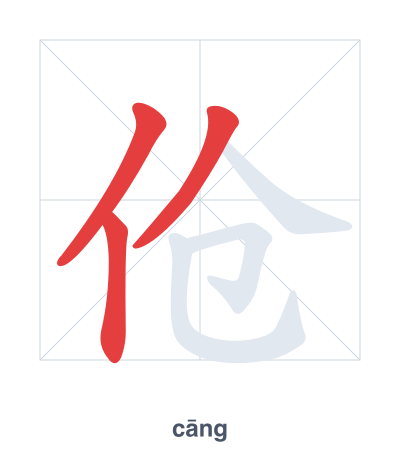
Open Hanzi Writer to see the animated stroke order and practice writing 伧 with real-time feedback.
The character 伧 (cāng/chen) is written with 6 strokes. Follow the standard Chinese stroke order: top to bottom, left to right, outside before inside. The radical 亻 is one of its key components.
Practice the correct stroke order with the Hanzi Writer app to see animated stroke-by-stroke guidance with real-time feedback.
伧 means Vulgar or lowly..
This is a polyphonic character with readings: cāng, chen.
伧 is a compound character combining the radical 亻 (person) with 仓 (cāng, storehouse or barn). The visual suggests a person associated with a barn, which anciently connoted a rustic or lowly status, hence the meaning 'vulgar or lowly.'
💡 Memory Tip: Picture a crude person (亻) eating from a feed trough inside a barn (仓) — they're vulgar and lowly.
这种行为很伧俗。
zhè zhǒng xíng wéi hěn cāng sú
This behavior is very vulgar.
他是个粗鲁的伧夫。
tā shì gè cū lǔ de cāng fū
He is a rude, unrefined fellow.
这件衣服太寒伧了。
zhè jiàn yī fú tài hán chen le
This piece of clothing is too shabby.
Open Hanzi Writer to see the animated stroke order and practice writing 伧 with real-time feedback.
✨ Animated stroke order · Handwriting recognition · HSK-graded practice · Free to use
伧 is composed of the radical 亻 (person) on the left and the phonetic component 仓 on the right. The person radical links it to human qualities, while 仓 adds the sound cāng and may suggest a rough or unrefined nature. Together, they convey a person who is vulgar or lowly.