镈 (bó) means "Bo (an ancient musical instrument or hoe)" in Chinese. It has 15 strokes with the radical 钅.
Rated 4.2/5 in difficulty (advanced).
Appears in 3+ common words including 镈钟 (bó zhōng), 编镈 (biān bó), 镈器 (bó qì).
Due to its 15 strokes, Hanzi Writer's error detection shows 镈 requires focused practice — most learners need 10+ attempts for consistent accuracy.
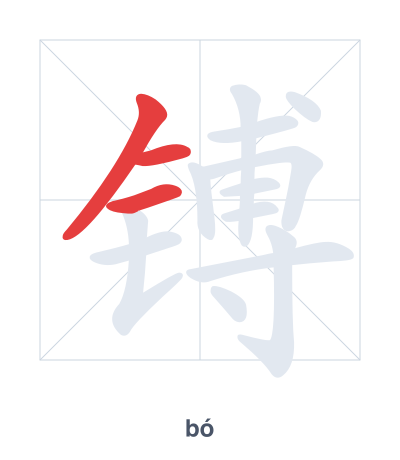
Open Hanzi Writer to see the animated stroke order and practice writing 镈 with real-time feedback.
The character 镈 (bó) is written with 15 strokes. Follow the standard Chinese stroke order: top to bottom, left to right, outside before inside. The radical 钅 is one of its key components.
Practice the correct stroke order with the Hanzi Writer app to see animated stroke-by-stroke guidance with real-time feedback.
镈 means Bo (an ancient musical instrument or hoe).
镈 is a phono-semantic compound: the radical 钅 (metal) indicates it relates to metal objects, and the component 尃 (fū) provides the sound. Originally it referred to a large ancient musical bell cast in metal, or later a metal hoe used in farming.
💡 Memory Tip: Picture a metal bell (钅) with a spreading shape (尃) that looks like a farmer swinging a hoe, making a 'bo' sound.
博物馆里有古代镈钟。
bó wù guǎn lǐ yǒu gǔ dài bó zhōng
There are ancient Bo bells in the museum.
编镈是古代的乐器。
biān bó shì gǔ dài de yuè qì
The bianbo is an ancient musical instrument.
专家在研究这些镈器。
zhuān jiā zài yán jiū zhè xiē bó qì
Experts are studying these ancient bells.
Open Hanzi Writer to see the animated stroke order and practice writing 镈 with real-time feedback.
✨ Animated stroke order · Handwriting recognition · HSK-graded practice · Free to use
The left side is 钅, the metal radical, showing that 镈 is made of metal. The right side is 尃, which hints at the pronunciation bó. Together, they form a character for a metal object like an ancient hoe or a large bell.