哱 (bō) means "Sound of a horn" in Chinese. It has 10 strokes with the radical 口.
Rated 4.2/5 in difficulty (advanced).
Appears in 3+ common words including 哱啰 (bō luō), 哱 (bō), 吹哱 (chuī bō).
Due to its 10 strokes, Hanzi Writer's error detection shows 哱 requires focused practice — most learners need 10+ attempts for consistent accuracy.
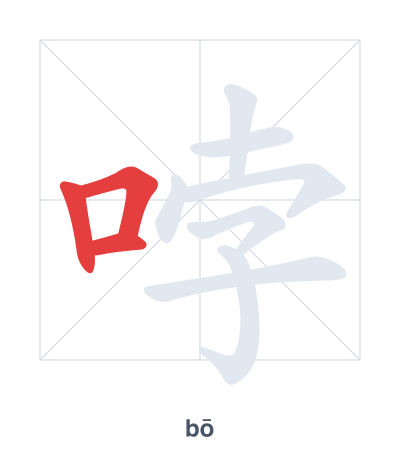
Open Hanzi Writer to see the animated stroke order and practice writing 哱 with real-time feedback.
The character 哱 (bō) is written with 10 strokes. Follow the standard Chinese stroke order: top to bottom, left to right, outside before inside. The radical 口 is one of its key components.
Practice the correct stroke order with the Hanzi Writer app to see animated stroke-by-stroke guidance with real-time feedback.
哱 means Sound of a horn.
This phono-semantic compound combines the mouth radical 口 (indicating a sound) with 孛, which provides the pronunciation bō. Together they depict the blast of a horn, as if the mouth emits a trumpet-like sound.
💡 Memory Tip: Picture a mouth (口) blowing into a horn shaped like 孛, producing a loud 'bō' sound.
他在吹哱啰。
tā zài chuī bō luō
He is blowing a horn.
这是一个古老的哱。
zhè shì yí gè gǔ lǎo de bō
This is an ancient trumpet.
士兵在练习吹哱。
shì bīng zài liàn xí chuī bō
The soldier is practicing blowing the horn.
Open Hanzi Writer to see the animated stroke order and practice writing 哱 with real-time feedback.
✨ Animated stroke order · Handwriting recognition · HSK-graded practice · Free to use
哱 uses the radical 口 (mouth) on the left, which indicates that the character involves sound or speech. The right part 孛 (bèi) gives the pronunciation bō. Together, the mouth makes the sound of a horn, matching the meaning "sound of a horn".