膑 (bìn) means "kneecap / patella" in Chinese. It has 14 strokes with the radical 月.
Rated 4.2/5 in difficulty (advanced).
Appears in 3+ common words including 孙膑 (sūn bìn), 膑刑 (bìn xíng), 膑骨 (bìn gǔ).
Due to its 14 strokes, Hanzi Writer's error detection shows 膑 requires focused practice — most learners need 10+ attempts for consistent accuracy.
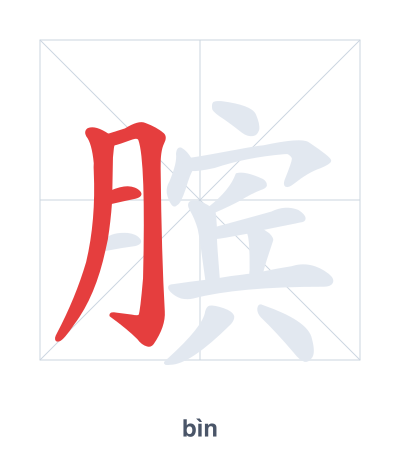
Open Hanzi Writer to see the animated stroke order and practice writing 膑 with real-time feedback.
The character 膑 (bìn) is written with 14 strokes. Follow the standard Chinese stroke order: top to bottom, left to right, outside before inside. The radical 月 is one of its key components.
Practice the correct stroke order with the Hanzi Writer app to see animated stroke-by-stroke guidance with real-time feedback.
膑 means kneecap / patella.
The left radical 月 (flesh/meat) indicates this character relates to a body part, while the right component 賓 (bīn, 'guest') gives the sound. In ancient China, the kneecap was associated with the cruel punishment of kneecap removal, called 膑刑.
💡 Memory Tip: Picture a guest (賓) kneeling so hard on the floor that their kneecap (月) cracks open.
孙膑是古代军事家。
sūn bìn shì gǔ dài jūn shì jiā
Sun Bin was an ancient military strategist.
膑刑是一种刑罚。
bìn xíng shì yī zhǒng xíng fá
Kneecap removal is a type of punishment.
他的膑骨受伤了。
tā de bìn gǔ shòu shāng le
His kneecap is injured.
Open Hanzi Writer to see the animated stroke order and practice writing 膑 with real-time feedback.
✨ Animated stroke order · Handwriting recognition · HSK-graded practice · Free to use
The left component is 月 (肉), meaning "flesh" or "body part," and the right component is 宾 (bīn), which provides a phonetic clue. Together they indicate a body part — the kneecap or patella — that sounds like bìn.