陛 (bì) means "steps to the throne" in Chinese. It has 9 strokes with the radical 阝.
Rated 3.7/5 in difficulty (challenging).
Appears in 3+ common words including 陛下 (bì xià), 阶陛 (jiē bì), 升陛 (shēng bì).
Due to its 9 strokes, Hanzi Writer's error detection shows 陛 requires focused practice — most learners need 10+ attempts for consistent accuracy.
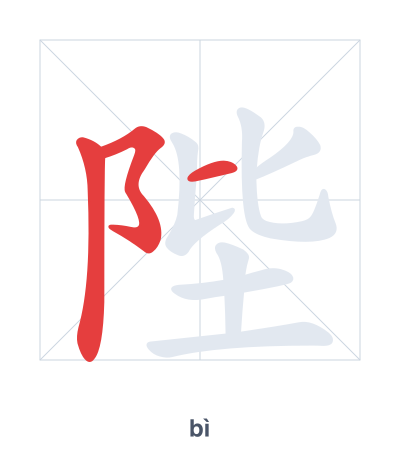
Open Hanzi Writer to see the animated stroke order and practice writing 陛 with real-time feedback.
The character 陛 (bì) is written with 9 strokes. Follow the standard Chinese stroke order: top to bottom, left to right, outside before inside. The radical 阝 is one of its key components.
Practice the correct stroke order with the Hanzi Writer app to see animated stroke-by-stroke guidance with real-time feedback.
陛 means steps to the throne.
The left radical 阝 (阜) depicts a mound or staircase, while the right component 坒 combines 比 (to compare or rank) and 土 (earth), together suggesting the tiered earth steps leading to a ruler's platform. This character originally referred to the steps ascending to the imperial throne in ancient Chinese palaces.
💡 Memory Tip: Picture the throne's steps as a mound of earth (土) where officials compare (比) their ranks while climbing the staircase (阝) to the emperor.
陛下请坐。
bì xià qǐng zuò
Please sit down, Your Majesty.
这里的阶陛很高。
zhè lǐ de jiē bì hěn gāo
The steps here are very high.
他在升陛上走。
tā zài shēng bì shàng zǒu
He is walking up the palace steps.
Open Hanzi Writer to see the animated stroke order and practice writing 陛 with real-time feedback.
✨ Animated stroke order · Handwriting recognition · HSK-graded practice · Free to use
The left component 阝 (yì) means a hill or mound, suggesting a high place. The right component 坒 (bì) gives the sound and also means layers or steps, so together the character represents steps leading up to a throne.