荜 (bì) means "Bean; pulse" in Chinese. It has 9 strokes with the radical 艹.
Rated 4/5 in difficulty (challenging).
Appears in 3+ common words including 蓬荜生辉 (péng bì shēng huī), 荜茇 (bì bá), 荜门 (bì mén).
Due to its 9 strokes, Hanzi Writer's error detection shows 荜 requires focused practice — most learners need 10+ attempts for consistent accuracy.
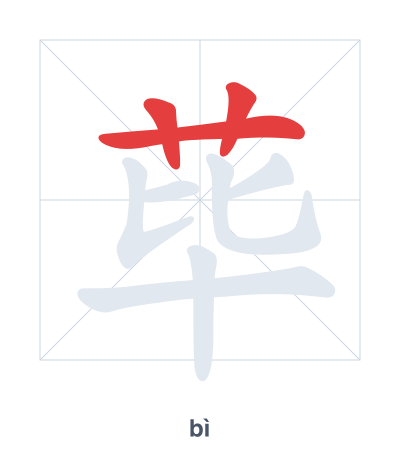
Open Hanzi Writer to see the animated stroke order and practice writing 荜 with real-time feedback.
The character 荜 (bì) is written with 9 strokes. Follow the standard Chinese stroke order: top to bottom, left to right, outside before inside. The radical 艹 is one of its key components.
Practice the correct stroke order with the Hanzi Writer app to see animated stroke-by-stroke guidance with real-time feedback.
荜 means Bean; pulse.
荜 combines the radical 艹 (grass, indicating a plant) with 毕 (bì, meaning 'to finish' or 'complete') as a phonetic component. It originally referred to a type of bean or pulse plant, emphasizing its botanical nature through the grass radical.
💡 Memory Tip: Picture a bean plant (艹) that has just finished (毕) growing, with pods full of beans ready to pick.
您的到来让这里蓬荜生辉。
nín de dào lái ràng zhè lǐ péng bì shēng huī
Your presence brings light to my humble home.
荜茇是一种中药材。
bì bá shì yī zhǒng zhōng yào cái
Long pepper is a type of Chinese medicinal herb.
他出生于荜门穷户。
tā chū shēng yú bì mén qióng hù
He was born into a poor and humble family.
Open Hanzi Writer to see the animated stroke order and practice writing 荜 with real-time feedback.
✨ Animated stroke order · Handwriting recognition · HSK-graded practice · Free to use
荜 (bì) is composed of the grass radical 艹 on top and the phonetic component 毕 (bì) underneath. The grass radical indicates that the character relates to plants, while 毕 provides pronunciation. Together they mean 'bean' or 'pulse,' referring to edible plants like beans.