茇 (bá) means "Grass roots / To camp out" in Chinese. It has 8 strokes with the radical 艹.
Rated 3.7/5 in difficulty (challenging).
Appears in 3+ common words including 茇舍 (bá shě), 根茇 (gēn bá), 茇茇 (bá bá).
Due to its 8 strokes, Hanzi Writer's error detection shows 茇 requires focused practice — most learners need 10+ attempts for consistent accuracy.
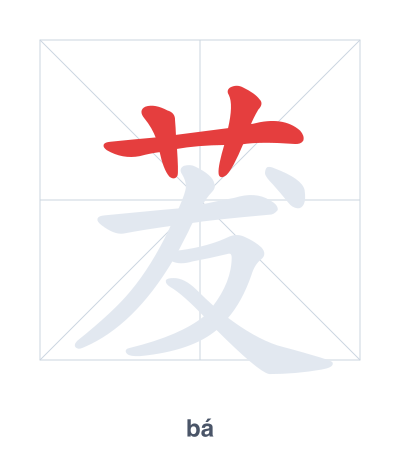
Open Hanzi Writer to see the animated stroke order and practice writing 茇 with real-time feedback.
The character 茇 (bá) is written with 8 strokes. Follow the standard Chinese stroke order: top to bottom, left to right, outside before inside. The radical 艹 is one of its key components.
Practice the correct stroke order with the Hanzi Writer app to see animated stroke-by-stroke guidance with real-time feedback.
茇 means Grass roots / To camp out.
This character is a phono-semantic compound: the grass radical (艹) indicates plants, while the component 犮 (bá, meaning 'dog running' or 'pull out') hints at the pronunciation and suggests pulling grass up by the roots. Originally it referred to the roots of grasses, later extended to the act of camping out by clearing grass to make a shelter.
💡 Memory Tip: Picture a dog (犮) digging up grass (艹) by the roots to make a cozy camping spot.
士兵们住在茇舍里。
shì bīng men zhù zài bá shě lǐ
The soldiers lived in thatched huts.
这种草的根茇很深。
zhè zhòng cǎo de gēn bá hěn shēn
The roots of this grass are very deep.
山上的草木茇茇。
shān shàng de cǎo mù bá bá
The vegetation on the mountain is thick and lush.
Open Hanzi Writer to see the animated stroke order and practice writing 茇 with real-time feedback.
✨ Animated stroke order · Handwriting recognition · HSK-graded practice · Free to use
The character 茇 combines the radical 艹 (grass) on top with 犮 (meaning to pull) below. This structure suggests grass roots that are pulled out, or the action of pulling grass to set up a temporary shelter. The component 犮 also gives the character its pronunciation bá.