愎 (bì) means "headstrong / perverse" in Chinese. It has 12 strokes with the radical 忄.
Rated 4.2/5 in difficulty (advanced).
Appears in 3+ common words including 刚愎自用 (gāng bì zì yòng), 刚愎 (gāng bì), 愎谏 (bì jiàn).
Due to its 12 strokes, Hanzi Writer's error detection shows 愎 requires focused practice — most learners need 10+ attempts for consistent accuracy.
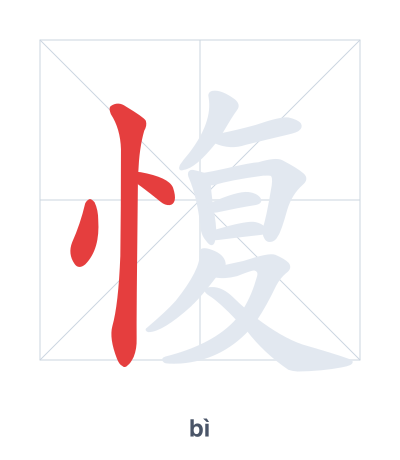
Open Hanzi Writer to see the animated stroke order and practice writing 愎 with real-time feedback.
The character 愎 (bì) is written with 12 strokes. Follow the standard Chinese stroke order: top to bottom, left to right, outside before inside. The radical 忄 is one of its key components.
Practice the correct stroke order with the Hanzi Writer app to see animated stroke-by-stroke guidance with real-time feedback.
愎 means headstrong / perverse.
The character 愎 combines the heart radical 忄 (xīn, meaning heart or mind) with 复 (fù, meaning 'to repeat' or 'to recover'). This suggests a heart or mind that stubbornly repeats its own perverse ways, refusing to change—hence the meaning 'headstrong' or 'perverse'. The component 复 also provides phonetic guidance for the pronunciation bì.
💡 Memory Tip: Picture a heart (忄) that stubbornly repeats the same mistake over and over (复) because it's too perverse to learn.
他这个人非常刚愎自用。
tā zhè ge rén fēi cháng gāng bì zì yòng
He is very headstrong and obstinate.
他的性格很刚愎。
tā de xìng gé hěn gāng bì
His personality is very headstrong and obstinate.
领导不能愎谏。
lǐng dǎo bù néng bì jiàn
A leader should not stubbornly reject advice.
Open Hanzi Writer to see the animated stroke order and practice writing 愎 with real-time feedback.
✨ Animated stroke order · Handwriting recognition · HSK-graded practice · Free to use
The left side is the radical 忄, which means heart or emotion. The right side is 复, which means to repeat or again. Together, they suggest a heart that repeatedly insists on its own way, leading to stubborn and headstrong behavior.