婢 (bì) means "Maidservant; slave girl (archaic)" in Chinese. It has 11 strokes with the radical 女.
Rated 4.2/5 in difficulty (advanced).
Appears in 3+ common words including 婢女 (bì nǚ), 奴婢 (nú bì), 侍婢 (shì bì).
Due to its 11 strokes, Hanzi Writer's error detection shows 婢 requires focused practice — most learners need 10+ attempts for consistent accuracy.
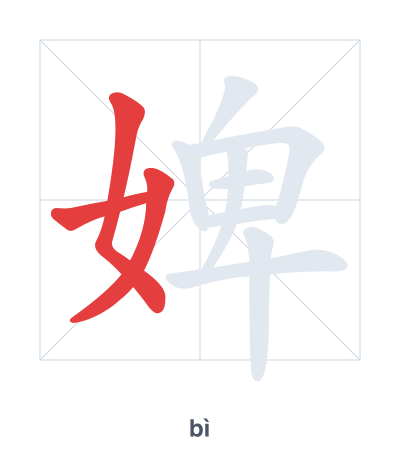
Open Hanzi Writer to see the animated stroke order and practice writing 婢 with real-time feedback.
The character 婢 (bì) is written with 11 strokes. Follow the standard Chinese stroke order: top to bottom, left to right, outside before inside. The radical 女 is one of its key components.
Practice the correct stroke order with the Hanzi Writer app to see animated stroke-by-stroke guidance with real-time feedback.
婢 means Maidservant; slave girl (archaic).
婢 combines the radical 女 (woman) with 卑 (low, humble), which also provides the sound. A maidservant is a woman of low status, and this compound visually expresses that idea.
💡 Memory Tip: Picture a woman (女) bowing low (卑) while holding a dustpan — she's a humble servant.
古代大户人家有婢女。
gǔ dài dà hù rén jiā yǒu bì nǚ
Wealthy ancient families had maidservants.
这是古代的一种称呼。
zhè shì gǔ dài de yī zhǒng chēng hū
This is a type of ancient address.
侍婢在旁边伺候主人。
shì bì zài páng biān cì hòu zhǔ rén
The maidservant is attending to the master by his side.
Open Hanzi Writer to see the animated stroke order and practice writing 婢 with real-time feedback.
✨ Animated stroke order · Handwriting recognition · HSK-graded practice · Free to use
The character 婢 is made of two parts: the left side 女 (woman) and the right side 卑 (bēi, meaning lowly or humble). The woman radical indicates that the character relates to a female person, while 卑 shows her low social status, together meaning a maidservant or slave girl.