俾 (bǐ) means "so that or in order to" in Chinese. It has 10 strokes with the radical 亻.
Rated 3.9/5 in difficulty (challenging).
Appears in 3+ common words including 俾使 (bǐ shǐ), 俾便 (bǐ biàn), 俾利 (bǐ lì).
Due to its 10 strokes, Hanzi Writer's error detection shows 俾 requires focused practice — most learners need 10+ attempts for consistent accuracy.
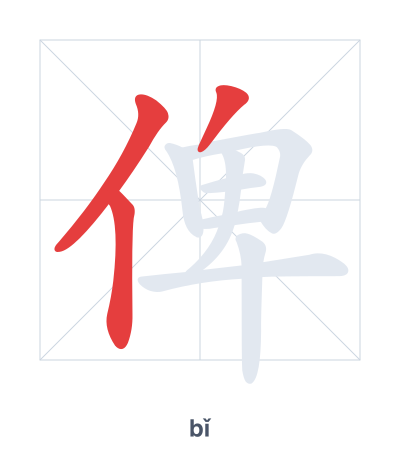
Open Hanzi Writer to see the animated stroke order and practice writing 俾 with real-time feedback.
The character 俾 (bǐ) is written with 10 strokes. Follow the standard Chinese stroke order: top to bottom, left to right, outside before inside. The radical 亻 is one of its key components.
Practice the correct stroke order with the Hanzi Writer app to see animated stroke-by-stroke guidance with real-time feedback.
俾 means so that or in order to.
俾 combines the radical 亻 (person) with 卑 (bēi, low/humble), which gives a phonetic clue. In ancient texts, it was used as a verb meaning 'to cause' or 'to make possible', suggesting a person enabling an action by taking a lowly position.
💡 Memory Tip: Imagine a person (亻) bowing low (卑) to hold a door open, saying 'please go first, so that you may pass.'
俾使大家明白。
bǐ shǐ dà jiā míng bái
So that everyone understands.
俾便日后查考。
bǐ biàn rì hòu chá kǎo
So as to facilitate future reference.
俾利于工作开展。
bǐ lì yú gōng zuò kāi zhǎn
So as to facilitate the progress of work.
Open Hanzi Writer to see the animated stroke order and practice writing 俾 with real-time feedback.
✨ Animated stroke order · Handwriting recognition · HSK-graded practice · Free to use
俾 combines the radical 亻 (person) on the left and 卑 (bēi, meaning low or humble) on the right. The character originally meant "to cause" or "to enable," suggesting a person helping someone low to achieve something. This evolved into the modern meaning "so that" or "in order to."