褓 (bǎo) means "swaddling clothes" in Chinese. It has 14 strokes with the radical 衤.
Rated 4.2/5 in difficulty (advanced).
Appears in 3+ common words including 襁褓 (qiǎng bǎo), 襁褓时期 (qiǎng bǎo shí qī), 褓抱 (bǎo bào).
Due to its 14 strokes, Hanzi Writer's error detection shows 褓 requires focused practice — most learners need 10+ attempts for consistent accuracy.
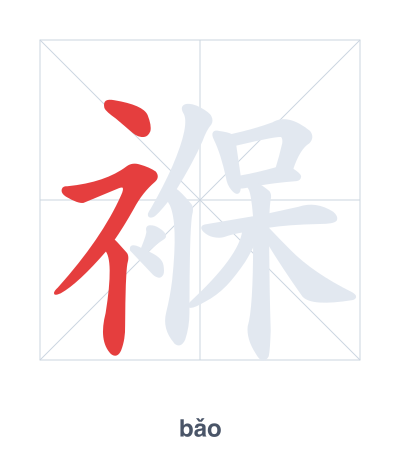
Open Hanzi Writer to see the animated stroke order and practice writing 褓 with real-time feedback.
The character 褓 (bǎo) is written with 14 strokes. Follow the standard Chinese stroke order: top to bottom, left to right, outside before inside. The radical 衤 is one of its key components.
Practice the correct stroke order with the Hanzi Writer app to see animated stroke-by-stroke guidance with real-time feedback.
褓 means swaddling clothes.
褓 combines the radical 衤 (clothing) with 保 (bǎo, to protect), which also provides the pronunciation. Together they depict a cloth used for protecting and wrapping a baby, hence swaddling clothes.
💡 Memory Tip: Picture a warm coat (衤) that says 'protect' (保) as it wraps snugly around a baby.
婴儿还在襁褓之中。
yīng ér hái zài qiǎng bǎo zhī zhōng
The baby is still in its infancy.
这是他襁褓时期的照片。
zhè shì tā qiǎng bǎo shí qī de zhào piān
This is a photo of him in his infancy.
孩子需要精心的褓抱。
hái zi xū yào jīng xīn de bǎo bào
The child needs careful nurturing.
Open Hanzi Writer to see the animated stroke order and practice writing 褓 with real-time feedback.
✨ Animated stroke order · Handwriting recognition · HSK-graded practice · Free to use
The left component is 衤, the clothing radical, showing the character relates to fabric. The right side is 保 (bǎo), which means "to protect" and gives the sound. Together, they create the idea of protective clothing for a baby, or swaddling clothes.