懊 (ào) means "regretful" in Chinese. It has 15 strokes with the radical 忄.
Rated 4.2/5 in difficulty (advanced).
Appears in 3+ common words including 懊恼 (ào nǎo), 懊悔 (ào huǐ), 懊丧 (ào sàng).
Due to its 15 strokes, Hanzi Writer's error detection shows 懊 requires focused practice — most learners need 10+ attempts for consistent accuracy.
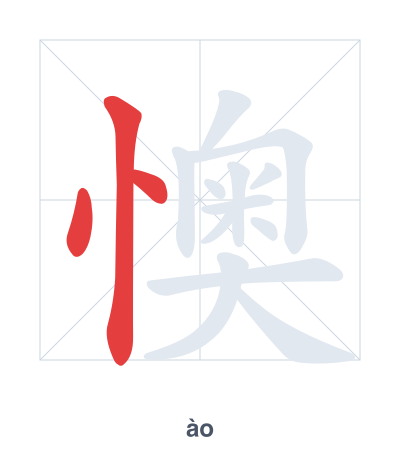
Open Hanzi Writer to see the animated stroke order and practice writing 懊 with real-time feedback.
The character 懊 (ào) is written with 15 strokes. Follow the standard Chinese stroke order: top to bottom, left to right, outside before inside. The radical 忄 is one of its key components.
Practice the correct stroke order with the Hanzi Writer app to see animated stroke-by-stroke guidance with real-time feedback.
懊 means regretful.
The character 懊 combines the heart radical 忄 (忄) with 奥 (ào), which originally meant 'deep, mysterious place' under a roof. The heart radical indicates an emotion, while 奥 suggests something hidden or troubling inside, together conveying the feeling of regret or remorse that gnaws at the heart.
💡 Memory Tip: Imagine a heart (忄) trapped in a deep, dark cave (奥), and you deeply regret ever entering it.
他感到很懊恼。
tā gǎn dào hěn ào nǎo
He felt very annoyed.
他对此感到懊悔。
tā duì cǐ gǎn dào ào huǐ
He feels regretful about this.
他的表情很懊丧。
tā de biǎo qíng hěn ào sàng
His expression was dejected.
Open Hanzi Writer to see the animated stroke order and practice writing 懊 with real-time feedback.
✨ Animated stroke order · Handwriting recognition · HSK-graded practice · Free to use
The left side is the heart radical 忄, connecting the character to emotions. The right side is 奥, which provides the sound ao and hints at something deep or inner, so the whole character means a deep feeling of regret or annoyance.