胙 (zuò) means "Sacrificial meat" in Chinese. It has 9 strokes with the radical 月.
Rated 4/5 in difficulty (challenging).
Appears in 3+ common words including 胙肉 (zuò ròu), 颁胙 (bān zuò), 受胙 (shòu zuò).
Due to its 9 strokes, Hanzi Writer's error detection shows 胙 requires focused practice — most learners need 10+ attempts for consistent accuracy.
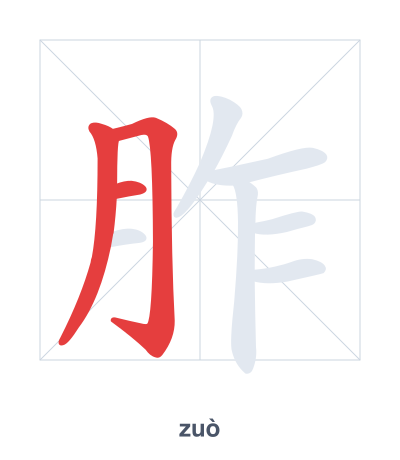
Open Hanzi Writer to see the animated stroke order and practice writing 胙 with real-time feedback.
The character 胙 (zuò) is written with 9 strokes. Follow the standard Chinese stroke order: top to bottom, left to right, outside before inside. The radical 月 is one of its key components.
Practice the correct stroke order with the Hanzi Writer app to see animated stroke-by-stroke guidance with real-time feedback.
胙 means Sacrificial meat.
胙 is a semantic-phonetic compound. The left radical 月 (a variant of 肉) signifies flesh or meat. The right component 乍 (zhà) provides the phonetic element, though its original meaning of 'suddenly' is not directly related; together, the character refers to the meat offered in sacrifices, a key part of ancient Chinese rituals.
💡 Memory Tip: Picture a slab of meat (月) placed on a tripod-shaped sacrificial stand (乍) as the holy 胙 offering.
这是祭祀用的胙肉。
zhè shì jì sì yòng de zuò ròu
This is the sacrificial meat used in rituals.
古代有颁胙的仪式。
gǔ dài yǒu bān zuò de yí shì
There was a ritual of distributing sacrificial meat in ancient times.
他代表家族受胙。
tā dài biǎo jiā zú shòu zuò
He received the sacrificial meat on behalf of the family.
Open Hanzi Writer to see the animated stroke order and practice writing 胙 with real-time feedback.
✨ Animated stroke order · Handwriting recognition · HSK-graded practice · Free to use
The character 胙 is formed by the radical 月 on the left, which represents flesh or meat, and the phonetic component 乍 on the right. Together, they create the meaning "sacrificial meat" — meat used in ancient offerings to gods or ancestors.