樽 (zūn) means "wine vessel" in Chinese. It has 16 strokes with the radical 木.
Rated 4.2/5 in difficulty (advanced).
Appears in 3+ common words including 酒樽 (jiǔ zūn), 金樽 (jīn zūn), 礼樽 (lǐ zūn).
Due to its 16 strokes, Hanzi Writer's error detection shows 樽 requires focused practice — most learners need 10+ attempts for consistent accuracy.
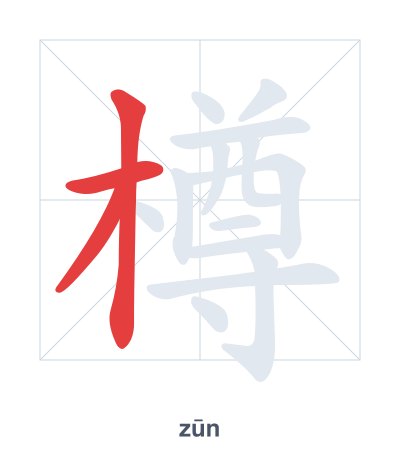
Open Hanzi Writer to see the animated stroke order and practice writing 樽 with real-time feedback.
The character 樽 (zūn) is written with 16 strokes. Follow the standard Chinese stroke order: top to bottom, left to right, outside before inside. The radical 木 is one of its key components.
Practice the correct stroke order with the Hanzi Writer app to see animated stroke-by-stroke guidance with real-time feedback.
樽 means wine vessel.
樽 combines the radical 木 (wood/tree) with 尊, a character that originally depicted hands holding a ritual wine vessel. Together, 樽 specifically denotes a wooden vessel used for holding wine, emphasizing both the material and the container's ceremonial function.
💡 Memory Tip: Imagine a tree (木) carved into a ceremonial cup that is offered with respect (尊) during a grand feast.
桌上放着一个酒樽。
zhuō shàng fàng zhe yí gè jiǔ zūn
There is a wine vessel on the table.
他举起金樽喝酒。
tā jǔ qǐ jīn zūn hē jiǔ
He raised the golden goblet to drink.
这是一个古老的礼樽。
zhè shì yí gè gǔ lǎo de lǐ zūn
This is an ancient ritual wine vessel.
Open Hanzi Writer to see the animated stroke order and practice writing 樽 with real-time feedback.
✨ Animated stroke order · Handwriting recognition · HSK-graded practice · Free to use
樽 is composed of the radical 木 (wood) on the left and the phonetic component 尊 on the right. The wood radical suggests the vessel was originally made of wood, while 尊 means "honor" or "vessel" and hints at the ceremonial use of such containers.