蕞 (zuì) means "Tiny / Small" in Chinese. It has 15 strokes with the radical 艹.
Rated 4.2/5 in difficulty (advanced).
Appears in 3+ common words including 蕞尔 (zuì ěr), 蕞尔小城 (zuì ěr xiǎo chéng), 蕞尔之地 (zuì ěr zhī dì).
Due to its 15 strokes, Hanzi Writer's error detection shows 蕞 requires focused practice — most learners need 10+ attempts for consistent accuracy.
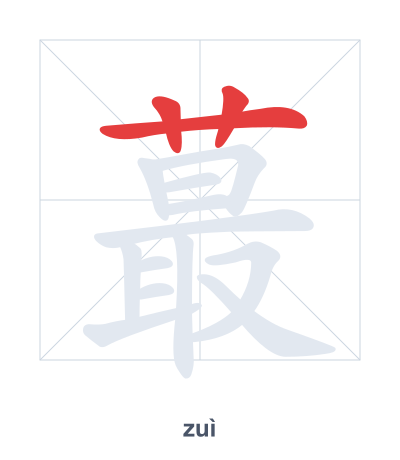
Open Hanzi Writer to see the animated stroke order and practice writing 蕞 with real-time feedback.
The character 蕞 (zuì) is written with 15 strokes. Follow the standard Chinese stroke order: top to bottom, left to right, outside before inside. The radical 艹 is one of its key components.
Practice the correct stroke order with the Hanzi Writer app to see animated stroke-by-stroke guidance with real-time feedback.
蕞 means Tiny / Small.
蕞 is a compound character with the grass radical 艹 (cǎo) on top and 最 (zuì, 'most') as a phonetic component. Its original meaning was 'small clump of grass', which extended to the sense of 'tiny' or 'insignificant'—the grass top evokes smallness, while 最 provides sound.
💡 Memory Tip: Picture a tiny blade of grass (艹) that is the most (最) miniature plant in the whole field—so small you almost miss it.
这是一个蕞尔小国。
zhè shì yí gè zuì ěr xiǎo guó
This is a tiny, insignificant country.
我住在一个蕞尔小城。
wǒ zhù zài yí gè zuì ěr xiǎo chéng
I live in a tiny little city.
这里只是蕞尔之地。
zhè lǐ zhǐ shì zuì ěr zhī dì
This is just a tiny, insignificant place.
Open Hanzi Writer to see the animated stroke order and practice writing 蕞 with real-time feedback.
✨ Animated stroke order · Handwriting recognition · HSK-graded practice · Free to use
蕞 is composed of the radical 艹 (grass) on top and the character 最 (zuì) below. 艹 indicates that the character is related to plants or vegetation, while 最 provides the pronunciation. The meaning "tiny" comes from classical usage, not directly from the components.