崒 (zú) means "high; precipitous" in Chinese. It has 11 strokes with the radical 山.
Rated 4.2/5 in difficulty (advanced).
Appears in 3+ common words including 崒屼 (zú wù), 崒律 (zú lǜ), 崒然 (zú rán).
Due to its 11 strokes, Hanzi Writer's error detection shows 崒 requires focused practice — most learners need 10+ attempts for consistent accuracy.
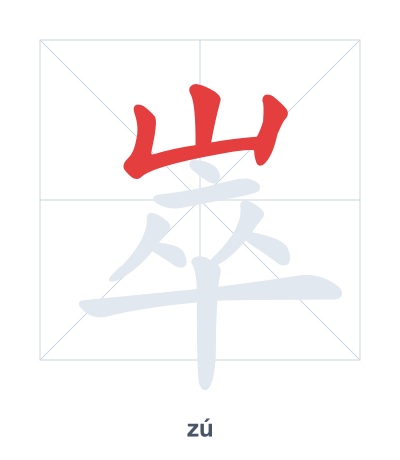
Open Hanzi Writer to see the animated stroke order and practice writing 崒 with real-time feedback.
The character 崒 (zú) is written with 11 strokes. Follow the standard Chinese stroke order: top to bottom, left to right, outside before inside. The radical 山 is one of its key components.
Practice the correct stroke order with the Hanzi Writer app to see animated stroke-by-stroke guidance with real-time feedback.
崒 means high; precipitous.
崒 is a phono-semantic compound combining the radical 山 (mountain) with 卒 (zú, soldier) as a phonetic component. The radical indicates the meaning relates to mountains, while the phonetic hints at the pronunciation and the idea of suddenness, evoking a steep, abrupt cliff face.
💡 Memory Tip: A soldier (卒) standing atop a mountain (山) peers down a breathtakingly high and precipitous drop.
山峰高大崒屼。
shān fēng gāo dà zú wù
The mountain peaks are tall and towering.
山势看起来很崒律。
shān shì kàn qǐ lái hěn zú lǜ
The mountain looks very high and steep.
高山崒然立在面前。
gāo shān zú rán lì zài miàn qián
A high mountain stands abruptly in front.
Open Hanzi Writer to see the animated stroke order and practice writing 崒 with real-time feedback.
✨ Animated stroke order · Handwriting recognition · HSK-graded practice · Free to use
崒 is composed of the radical 山 (mountain) on the left, indicating the character relates to mountains or terrain. The right part is 卒 (zú), which provides the sound and also suggests the idea of suddenness or abruptness, reinforcing the meaning of high and precipitous.