渍 (zì) means "To stain or soak." in Chinese. It has 11 strokes with the radical 氵.
Rated 4.2/5 in difficulty (advanced).
Appears in 3+ common words including 油渍 (yóu zì), 污渍 (wū zì), 浸渍 (jìn zì).
Due to its 11 strokes, Hanzi Writer's error detection shows 渍 requires focused practice — most learners need 10+ attempts for consistent accuracy.
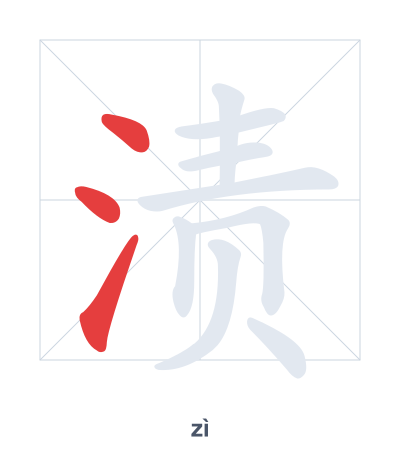
Open Hanzi Writer to see the animated stroke order and practice writing 渍 with real-time feedback.
The character 渍 (zì) is written with 11 strokes. Follow the standard Chinese stroke order: top to bottom, left to right, outside before inside. The radical 氵 is one of its key components.
Practice the correct stroke order with the Hanzi Writer app to see animated stroke-by-stroke guidance with real-time feedback.
渍 means To stain or soak..
The character 渍 combines the water radical 氵, indicating its connection to liquids, with the phonetic component 责 (zé), which originally meant 'to demand' but here provides the sound. The water radical suggests the action of water or liquid interacting with something, while the phonetic part hints at the pronunciation. Over time, the character came to mean 'to soak' or 'to stain', reflecting the idea of liquid penetrating or leaving a mark.
💡 Memory Tip: Imagine a piece of cloth soaked in water (氵) that gets a stain (like a 'z' mark) because it was left in a puddle too long, and the water '责' (demands) you to clean it up.
衣服上有油渍。
yī fú shàng yǒu yóu zì
There are oil stains on the clothes.
这种污渍很难洗。
zhè zhǒng wū zì hěn nán xǐ
This stain is hard to wash out.
纸被水浸渍了。
zhǐ bèi shuǐ jìn zì le
The paper was soaked in water.
Open Hanzi Writer to see the animated stroke order and practice writing 渍 with real-time feedback.
✨ Animated stroke order · Handwriting recognition · HSK-graded practice · Free to use
渍 is composed of the water radical 氵 on the left and the phonetic component 责 on the right. The water radical directly points to the involvement of liquid, which is essential for soaking or staining. The right part, 责, primarily provides the sound 'ze' but also adds a nuance of 'burden' or 'responsibility', as a stain can be seen as a burden on the material. Together, the structure visually and phonetically encodes the idea of liquid causing a mark or soak.