濯 (zhuó) means "to wash; to cleanse" in Chinese. It has 17 strokes with the radical 氵.
Rated 4.2/5 in difficulty (advanced).
Appears in 3+ common words including 洗濯 (xǐ zhuó), 濯足 (zhuó zú), 濯濯 (zhuó zhuó).
Due to its 17 strokes, Hanzi Writer's error detection shows 濯 requires focused practice — most learners need 10+ attempts for consistent accuracy.
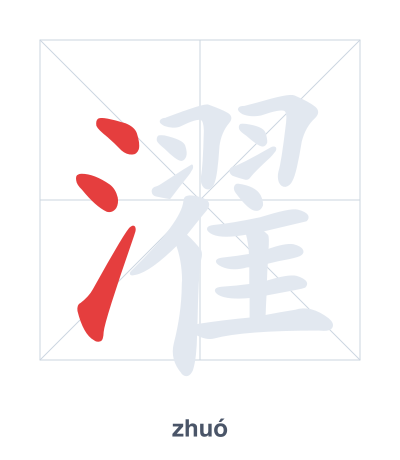
Open Hanzi Writer to see the animated stroke order and practice writing 濯 with real-time feedback.
The character 濯 (zhuó) is written with 17 strokes. Follow the standard Chinese stroke order: top to bottom, left to right, outside before inside. The radical 氵 is one of its key components.
Practice the correct stroke order with the Hanzi Writer app to see animated stroke-by-stroke guidance with real-time feedback.
濯 means to wash; to cleanse.
This character is a phono-semantic compound: the water radical (氵) indicates washing with water, while 翟 (dí, a long-tailed bird) provides the pronunciation. Together they convey the idea of cleansing something thoroughly, like washing feathers.
💡 Memory Tip: Picture a dirty long-tailed bird (翟) standing under a waterfall (氵) to wash itself clean.
妈妈在河边洗濯衣服。
mā mā zài hé biān xǐ zhuó yī fú
Mom is washing clothes by the river.
他在小溪边濯足。
tā zài xiǎo xī biān zhuó zú
He is washing his feet in the stream.
那座山上草木濯濯。
nà zuò shān shàng cǎo mù zhuó zhuó
That mountain is bare of vegetation.
Open Hanzi Writer to see the animated stroke order and practice writing 濯 with real-time feedback.
✨ Animated stroke order · Handwriting recognition · HSK-graded practice · Free to use
濯 has the water radical 氵 on the left, indicating the action involves water. The right part is 翟, which originally depicted a long-tailed bird's feathers, suggesting cleaning or brightening feathers with water. Together, they convey the idea of washing or cleansing.