蛀 (zhù) means "To bore (by insects) / To decay" in Chinese. It has 11 strokes with the radical 虫.
Rated 4.2/5 in difficulty (advanced).
Appears in 3+ common words including 蛀牙 (zhù yá), 蛀虫 (zhù chóng), 被蛀 (bèi zhù).
Due to its 11 strokes, Hanzi Writer's error detection shows 蛀 requires focused practice — most learners need 10+ attempts for consistent accuracy.
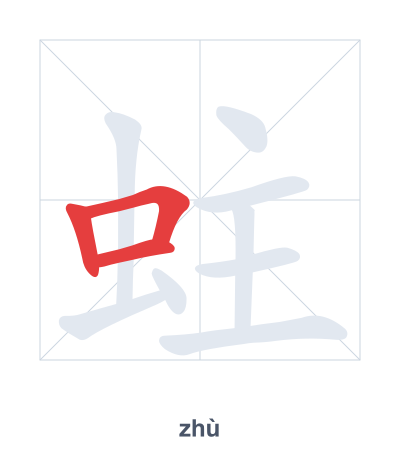
Open Hanzi Writer to see the animated stroke order and practice writing 蛀 with real-time feedback.
The character 蛀 (zhù) is written with 11 strokes. Follow the standard Chinese stroke order: top to bottom, left to right, outside before inside. The radical 虫 is one of its key components.
Practice the correct stroke order with the Hanzi Writer app to see animated stroke-by-stroke guidance with real-time feedback.
蛀 means To bore (by insects) / To decay.
蛀 is a phono-semantic compound: the radical 虫 (insect) indicates the meaning relates to insects, while 主 (zhǔ, 'master') provides the pronunciation. The character depicts insects that are 'masters' of boring into wood, teeth, or other materials, causing decay.
💡 Memory Tip: Picture a worm (虫) acting like a 'master' (主) builder, drilling tunnels through a wooden plank until it crumbles.
我有一颗蛀牙。
wǒ yǒu yī kē zhù yá
I have a cavity.
书里有蛀虫。
shū lǐ yǒu zhù chóng
There are bookworms in the book.
木头被蛀了。
mù tou bèi zhù le
The wood is worm-eaten.
Open Hanzi Writer to see the animated stroke order and practice writing 蛀 with real-time feedback.
✨ Animated stroke order · Handwriting recognition · HSK-graded practice · Free to use
蛀 combines the radical 虫 (insect) on the left with the phonetic component 主 (zhǔ) on the right. The insect radical connects to the meaning of insects boring or decaying, while 主 hints at the pronunciation zhù.