蛛 (zhū) means "spider" in Chinese. It has 12 strokes with the radical 虫.
Rated 4.2/5 in difficulty (advanced).
Appears in 3+ common words including 蜘蛛 (zhī zhū), 蜘蛛网 (zhī zhū wǎng), 蜘蛛侠 (zhī zhū xiá).
Due to its 12 strokes, Hanzi Writer's error detection shows 蛛 requires focused practice — most learners need 10+ attempts for consistent accuracy.
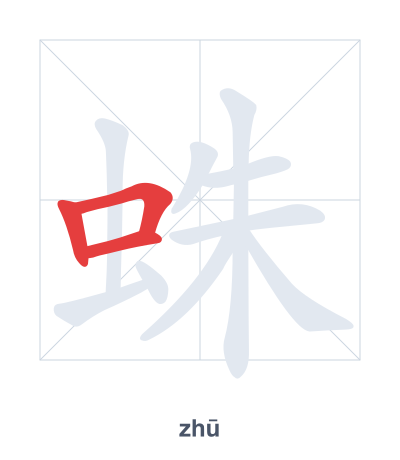
Open Hanzi Writer to see the animated stroke order and practice writing 蛛 with real-time feedback.
The character 蛛 (zhū) is written with 12 strokes. Follow the standard Chinese stroke order: top to bottom, left to right, outside before inside. The radical 虫 is one of its key components.
Practice the correct stroke order with the Hanzi Writer app to see animated stroke-by-stroke guidance with real-time feedback.
蛛 means spider.
蛛 is a phono-semantic compound: the left radical 虫 (insect/creature) indicates the meaning 'spider', while the right component 朱 (zhū, red) provides the pronunciation. The character was created by combining a general creature radical with a sound element that echoes the spoken word for spider.
💡 Memory Tip: Picture a red (朱) spider (虫) with tiny red spots on its back, spinning a bright red web.
墙角有一只大蜘蛛。
qiáng jiǎo yǒu yī zhī dà zhī zhū
There is a big spider in the corner.
树上挂着一个蜘蛛网。
shù shàng guà zhe yí gè zhī zhū wǎng
A spider web is hanging in the tree.
我很喜欢看蜘蛛侠。
wǒ hěn xǐ huān kàn zhī zhū xiá
I really like watching Spider-Man.
Open Hanzi Writer to see the animated stroke order and practice writing 蛛 with real-time feedback.
✨ Animated stroke order · Handwriting recognition · HSK-graded practice · Free to use
蛛 is composed of the radical 虫 on the left, meaning insect or bug, and 朱 on the right, which provides the pronunciation zhū. Since a spider is an arachnid, not an insect, the 虫 radical still broadly suggests a small creature, making this a phono-semantic compound.