胄 (zhòu) means "Descendant / Helmet" in Chinese. It has 9 strokes with the radical 月.
Rated 4/5 in difficulty (challenging).
Appears in 3+ common words including 甲胄 (jiǎ zhòu), 贵胄 (guì zhòu), 胄子 (zhòu zi).
Due to its 9 strokes, Hanzi Writer's error detection shows 胄 requires focused practice — most learners need 10+ attempts for consistent accuracy.
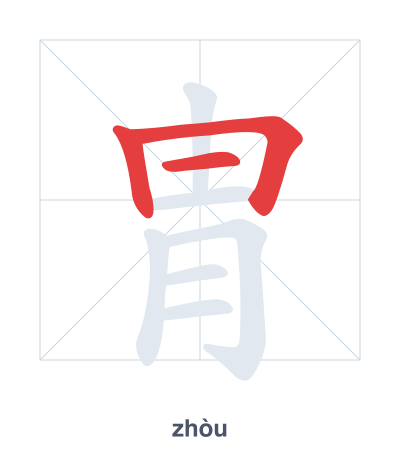
Open Hanzi Writer to see the animated stroke order and practice writing 胄 with real-time feedback.
The character 胄 (zhòu) is written with 9 strokes. Follow the standard Chinese stroke order: top to bottom, left to right, outside before inside. The radical 月 is one of its key components.
Practice the correct stroke order with the Hanzi Writer app to see animated stroke-by-stroke guidance with real-time feedback.
胄 means Descendant / Helmet.
Originally, 胄 represented two different characters: 冑 (helmet) with 冃 (hat) + 由, and 胄 (descendant) with ⺼ (flesh) + 由 (lineage). They merged into the modern form 胄, where the top 由 suggests a helmet’s shape or a bloodline, and the bottom 月 (flesh) indicates the body wearing the helmet or the flesh of descendants.
💡 Memory Tip: Picture a helmet (由) made of flesh (月) passed from ancestor to descendant — the helmet protects the head, but the flesh carries the bloodline.
博物馆里有古代甲胄。
bó wù guǎn lǐ yǒu gǔ dài jiǎ zhòu
There is ancient armor in the museum.
他是名门贵胄。
tā shì míng mén guì zhòu
He is of noble birth.
胄子在古代指长子。
zhòu zi zài gǔ dài zhǐ zhǎng zǐ
In ancient times, 'zhouzi' referred to the eldest son.
Open Hanzi Writer to see the animated stroke order and practice writing 胄 with real-time feedback.
✨ Animated stroke order · Handwriting recognition · HSK-graded practice · Free to use
The character 胄 is made of 由 on top and 月 on the bottom. For the meaning "descendant," 由 suggests "from" and 月 represents flesh or bloodline, so together they mean "flesh from a lineage." For the meaning "helmet," the top part 由 resembles the shape of a helmet covering the head, while 月 represents the body.