蛭 (zhì) means "Leech" in Chinese. It has 12 strokes with the radical 虫.
Rated 4.2/5 in difficulty (advanced).
Appears in 3+ common words including 水蛭 (shuǐ zhì), 蚂蛭 (mǎ zhì), 蛭类 (zhì lèi).
Due to its 12 strokes, Hanzi Writer's error detection shows 蛭 requires focused practice — most learners need 10+ attempts for consistent accuracy.
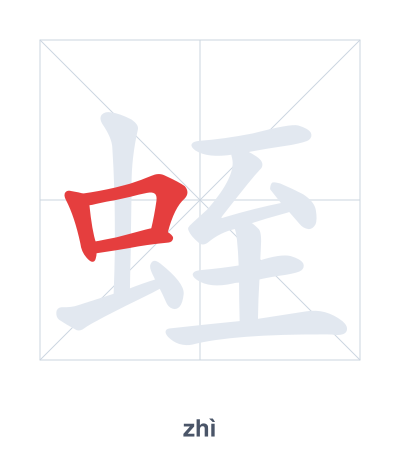
Open Hanzi Writer to see the animated stroke order and practice writing 蛭 with real-time feedback.
The character 蛭 (zhì) is written with 12 strokes. Follow the standard Chinese stroke order: top to bottom, left to right, outside before inside. The radical 虫 is one of its key components.
Practice the correct stroke order with the Hanzi Writer app to see animated stroke-by-stroke guidance with real-time feedback.
蛭 means Leech.
蛭 is a phono-semantic compound combining the radical 虫 (insect/creature) with 至 (zhì, 'to arrive') as a phonetic hint. The leech is a parasitic worm that 'arrives' to attach itself to a host for blood.
💡 Memory Tip: Imagine a leech (虫) arriving (至) to latch onto your leg—now you'll never forget 蛭 means 'leech'!
水里有一只水蛭。
shuǐ lǐ yǒu yī zhī shuǐ zhì
There is a leech in the water.
他很怕蚂蛭。
tā hěn pà mǎ zhì
He is very afraid of leeches.
老师在讲蛭类动物。
lǎo shī zài jiǎng zhì lèi dòng wù
The teacher is teaching about leeches.
Open Hanzi Writer to see the animated stroke order and practice writing 蛭 with real-time feedback.
✨ Animated stroke order · Handwriting recognition · HSK-graded practice · Free to use
蛭 is composed of the radical 虫 (insect or worm) on the left, which indicates it is a type of creature. The right part 至 (zhì) gives the pronunciation and originally functioned as a phonetic component. Together, 虫 + 至 means "leech," a blood-sucking worm.