埴 (zhí) means "clay / loamy soil" in Chinese. It has 11 strokes with the radical 土.
Rated 4.2/5 in difficulty (advanced).
Appears in 3+ common words including 埴土 (zhí tǔ), 陶埴 (táo zhí), 粘埴 (zhān zhí).
Due to its 11 strokes, Hanzi Writer's error detection shows 埴 requires focused practice — most learners need 10+ attempts for consistent accuracy.
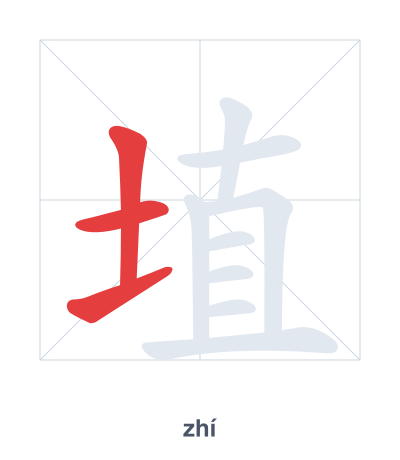
Open Hanzi Writer to see the animated stroke order and practice writing 埴 with real-time feedback.
The character 埴 (zhí) is written with 11 strokes. Follow the standard Chinese stroke order: top to bottom, left to right, outside before inside. The radical 土 is one of its key components.
Practice the correct stroke order with the Hanzi Writer app to see animated stroke-by-stroke guidance with real-time feedback.
埴 means clay / loamy soil.
埴 is a phono-semantic compound: the radical 土 ('earth') indicates its connection to soil, while 直 (zhí, 'straight') provides the pronunciation. The character thus literally means 'straight earth,' referring to fine, cohesive clay that can be shaped or straightened for pottery.
💡 Memory Tip: Imagine pressing a straight ruler (直) into soft clay (土) to shape it into a perfect brick.
这种埴土很黏。
zhè zhǒng zhí tǔ hěn nián
This clayey soil is very sticky.
他喜欢研究陶埴。
tā xǐ huān yán jiū táo zhí
He likes studying pottery and ceramics.
泥土非常粘埴。
ní tǔ fēi cháng zhān zhí
The soil is very clayey.
Open Hanzi Writer to see the animated stroke order and practice writing 埴 with real-time feedback.
✨ Animated stroke order · Handwriting recognition · HSK-graded practice · Free to use
埴 combines the radical 土 (earth) on the left, which directly relates to soil or clay, and the component 直 (zhí, meaning 'straight') on the right. The right part gives the pronunciation and also hints at the idea of 'direct' or 'pure' earth, referring to fine clay used for pottery.