祗 (zhī) means "respectfully; only" in Chinese. It has 9 strokes with the radical 礻.
Rated 4/5 in difficulty (challenging).
Appears in 3+ common words including 祗候 (zhī hòu), 祗领 (zhī lǐng), 祗奉 (zhī fèng).
Due to its 9 strokes, Hanzi Writer's error detection shows 祗 requires focused practice — most learners need 10+ attempts for consistent accuracy.
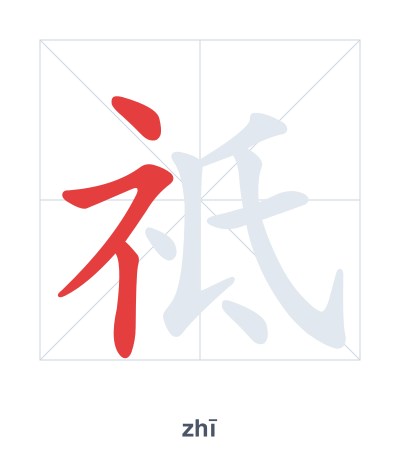
Open Hanzi Writer to see the animated stroke order and practice writing 祗 with real-time feedback.
The character 祗 (zhī) is written with 9 strokes. Follow the standard Chinese stroke order: top to bottom, left to right, outside before inside. The radical 礻 is one of its key components.
Practice the correct stroke order with the Hanzi Writer app to see animated stroke-by-stroke guidance with real-time feedback.
祗 means respectfully; only.
祗 combines the radical 礻 (示, meaning spirit or altar) with 氐 (dī, meaning base or to reach), suggesting a reverent attitude of reaching toward the divine foundation. It historically conveyed deep respect in ritual contexts, later extending to mean 'only' as a humble expression.
💡 Memory Tip: Picture a respectful person (礻) kneeling at the base (氐) of an ancestral altar, bowing low and saying 'only with utmost reverence.'
属下在门外祗候。
shǔ xià zài mén wài zhī hòu
Your subordinate is waiting outside the door.
祗领这份厚礼。
zhī lǐng zhè fèn hòu lǐ
Respectfully receive this generous gift.
祗奉长辈是美德。
zhī fèng zhǎng bèi shì měi dé
Serving elders respectfully is a virtue.
Open Hanzi Writer to see the animated stroke order and practice writing 祗 with real-time feedback.
✨ Animated stroke order · Handwriting recognition · HSK-graded practice · Free to use
The character 祗 is composed of the radical 礻 (which relates to spirits or rituals) on the left, and the component 氏 (meaning 'clan' or 'family') on the right. Together, they suggest showing respect toward one's ancestral clan, which matches the character's meaning of 'respectfully'.