圳 (zhèn) means "Ditch / Irrigation channel" in Chinese. It has 6 strokes with the radical 土.
Rated 3.2/5 in difficulty (challenging).
Appears in 3+ common words including 深圳 (shēn zhèn), 田圳 (tián zhèn), 圳沟 (zhèn gōu).
Due to its 6 strokes, Hanzi Writer's error detection shows 圳 requires focused practice — most learners need 10+ attempts for consistent accuracy.
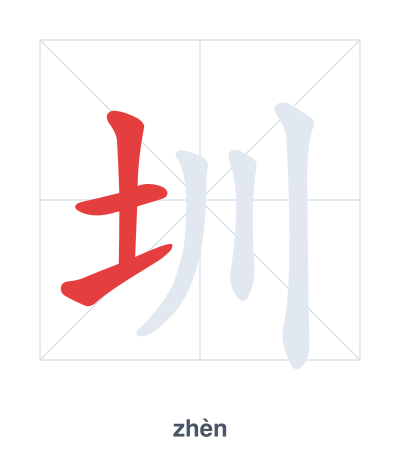
Open Hanzi Writer to see the animated stroke order and practice writing 圳 with real-time feedback.
The character 圳 (zhèn) is written with 6 strokes. Follow the standard Chinese stroke order: top to bottom, left to right, outside before inside. The radical 土 is one of its key components.
Practice the correct stroke order with the Hanzi Writer app to see animated stroke-by-stroke guidance with real-time feedback.
圳 means Ditch / Irrigation channel.
The character 圳 combines the radical 土 (earth, ground) on the left with 川 (river, stream) on the right. Together, 'earth' and 'river' depict a man-made channel or ditch dug into the ground to carry water for irrigation.
💡 Memory Tip: Imagine a farmer digging a trench (土) with three wavy lines (川) of water flowing through it, forming a perfect irrigation ditch.
深圳是一个大城市。
shēn zhèn shì yí gè dà chéng shì
Shenzhen is a big city.
田圳里有很多水。
tián zhèn lǐ yǒu hěn duō shuǐ
There is a lot of water in the field ditch.
水流进了圳沟。
shuǐ liú jìn le zhèn gōu
Water flowed into the irrigation ditch.
Open Hanzi Writer to see the animated stroke order and practice writing 圳 with real-time feedback.
✨ Animated stroke order · Handwriting recognition · HSK-graded practice · Free to use
The character 圳 combines the radical 土 (earth/ground) on the left and 川 (chuān, meaning river or stream) on the right. The 土 radical shows it relates to land or soil, while 川 represents flowing water, together forming the idea of a man-made water channel in the earth—an irrigation ditch.