帻 (zé) means "Turban / Headgear" in Chinese. It has 11 strokes with the radical 巾.
Rated 4.2/5 in difficulty (advanced).
Appears in 3+ common words including 头帻 (tóu zé), 巾帻 (jīn zé), 弁帻 (biàn zé).
Due to its 11 strokes, Hanzi Writer's error detection shows 帻 requires focused practice — most learners need 10+ attempts for consistent accuracy.
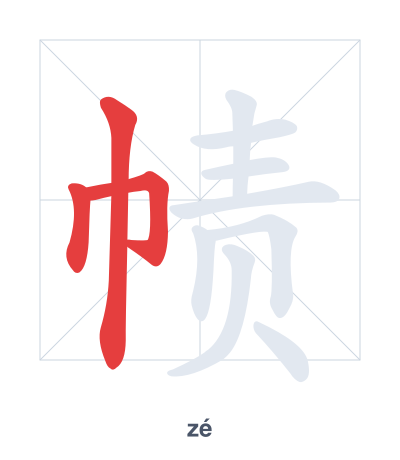
Open Hanzi Writer to see the animated stroke order and practice writing 帻 with real-time feedback.
The character 帻 (zé) is written with 11 strokes. Follow the standard Chinese stroke order: top to bottom, left to right, outside before inside. The radical 巾 is one of its key components.
Practice the correct stroke order with the Hanzi Writer app to see animated stroke-by-stroke guidance with real-time feedback.
帻 means Turban / Headgear.
The character 帻 is a phono-semantic compound. The radical 巾 (cloth) indicates that it refers to a type of fabric headwear, while the component 责 provides the pronunciation 'zé'.
💡 Memory Tip: Imagine a cloth (巾) wrapped tightly around your head, with the knot looking like the character 责 sitting on top like a stylish turban.
他戴着青色头帻。
tā dài zhe qīng sè tóu zé
He is wearing a blue headscarf.
古人常戴巾帻。
gǔ rén cháng dài jīn zé
Ancient people often wore headscarves or turbans.
弁帻是古代服饰。
biàn zé shì gǔ dài fú shì
The bianze is a type of ancient clothing.
Open Hanzi Writer to see the animated stroke order and practice writing 帻 with real-time feedback.
✨ Animated stroke order · Handwriting recognition · HSK-graded practice · Free to use
The character 帻 is a left-right structure. The left part is the radical 巾 (cloth), which shows that the character relates to cloth or headwear. The right part is 责 (zé, responsibility), which gives the sound and hints that this headgear was a common item for which one had responsibility.