枣 (zǎo) means "jujube; Chinese date" in Chinese. It has 8 strokes with the radical 木, and is HSK Level 7.
Rated 3.4/5 in difficulty (challenging).
Harder than 14% of HSK Level 7 characters.
Appears in 3+ common words including 红枣 (hóng zǎo), 枣树 (zǎo shù), 枣泥 (zǎo ní).
Due to its 8 strokes, Hanzi Writer's error detection shows 枣 requires focused practice — most learners need 10+ attempts for consistent accuracy.
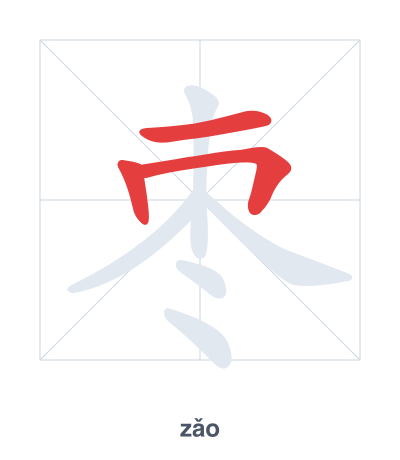
Open Hanzi Writer to see the animated stroke order and practice writing 枣 with real-time feedback.
The character 枣 (zǎo) is written with 8 strokes. Follow the standard Chinese stroke order: top to bottom, left to right, outside before inside. The radical 木 is one of its key components.
Practice the correct stroke order with the Hanzi Writer app to see animated stroke-by-stroke guidance with real-time feedback.
枣 means jujube; Chinese date.
As an HSK Level 7 character, 枣 is an intermediate-level character.
枣 (zǎo) is a compound character combining 朿 (cì, meaning 'thorn') on top and 木 (mù, 'tree') below. The 朿 element visually represents the thorny branches of the jujube tree, which bears the edible fruit. Thus the character depicts a thorny tree, directly linking to the jujube or Chinese date.
💡 Memory Tip: Picture a tree (木) with two sharp thorns (the 朿 part) poking out—when you reach for the sweet dates, you get pricked; 'Ouch, that's a 枣!'
红枣对身体很好。
hóng zǎo duì shēn tǐ hěn hǎo
Red dates are very good for the body.
院子里有一棵枣树。
yuàn zi lǐ yǒu yī kē zǎo shù
There is a jujube tree in the yard.
这个包子是枣泥馅的。
zhè ge bāo zi shì zǎo ní xiàn de
This bun has jujube paste filling.
Open Hanzi Writer to see the animated stroke order and practice writing 枣 with real-time feedback.
✨ Animated stroke order · Handwriting recognition · HSK-graded practice · Free to use
枣 is composed of the radical 木 (tree) on top and the component 朿 (thorn) below. This combination represents a thorny tree, which matches the jujube tree that has thorns on its branches.