蓣 (yù) means "yam" in Chinese. It has 13 strokes with the radical 艹.
Rated 4.2/5 in difficulty (advanced).
Appears in 3+ common words including 山蓣 (shān yù), 薯蓣 (shǔ yù), 蓣薯 (yù shǔ).
Due to its 13 strokes, Hanzi Writer's error detection shows 蓣 requires focused practice — most learners need 10+ attempts for consistent accuracy.
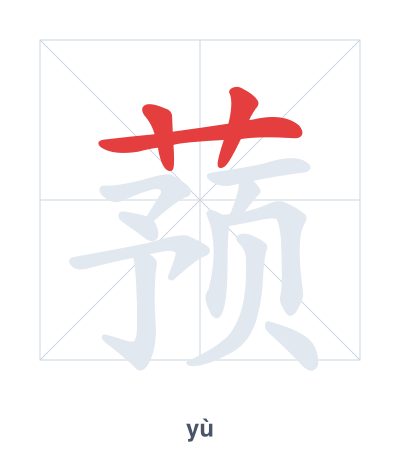
Open Hanzi Writer to see the animated stroke order and practice writing 蓣 with real-time feedback.
The character 蓣 (yù) is written with 13 strokes. Follow the standard Chinese stroke order: top to bottom, left to right, outside before inside. The radical 艹 is one of its key components.
Practice the correct stroke order with the Hanzi Writer app to see animated stroke-by-stroke guidance with real-time feedback.
蓣 means yam.
蓣 is a phono-semantic compound: the grass radical (艹) signifies it's a plant, while 预 (yù, 'to prepare') provides the pronunciation. It appears in the compound 薯蓣 (shǔyù, yam), referring to the edible tuber.
💡 Memory Tip: Picture a yam wearing a grass hat (艹) being prepared (预) for a feast.
山蓣也叫山药。
shān yù yě jiào shān yào
Chinese yam is also known as Shanyao.
薯蓣的营养很高。
shǔ yù de yíng yǎng hěn gāo
Chinese yam is very nutritious.
这种蓣薯很甜。
zhè zhǒng yù shǔ hěn tián
This yam is very sweet.
Open Hanzi Writer to see the animated stroke order and practice writing 蓣 with real-time feedback.
✨ Animated stroke order · Handwriting recognition · HSK-graded practice · Free to use
蓣 has two parts: the radical 艹 (grass) on top and 豫 (yù) below. Since yam is a plant, the grass radical hints at its botanical nature. The lower part 豫 provides the pronunciation and also means 'prepared' or 'comfortable', but its role here is mainly phonetic.