嵛 (yú) means "Yu (mountain name)" in Chinese. It has 12 strokes with the radical 山.
Rated 4.2/5 in difficulty (advanced).
Appears in 3+ common words including 昆嵛山 (kūn yú shān), 嵛山岛 (yú shān dǎo), 嵛岭 (yú lǐng).
Due to its 12 strokes, Hanzi Writer's error detection shows 嵛 requires focused practice — most learners need 10+ attempts for consistent accuracy.
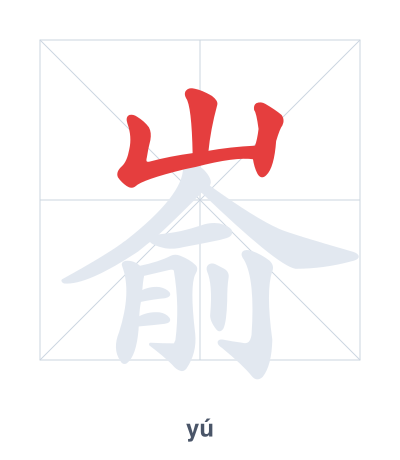
Open Hanzi Writer to see the animated stroke order and practice writing 嵛 with real-time feedback.
The character 嵛 (yú) is written with 12 strokes. Follow the standard Chinese stroke order: top to bottom, left to right, outside before inside. The radical 山 is one of its key components.
Practice the correct stroke order with the Hanzi Writer app to see animated stroke-by-stroke guidance with real-time feedback.
嵛 means Yu (mountain name).
嵛 is a phono-semantic compound. The radical 山 (mountain) indicates it is a mountain name. The component 俞 (yú) provides the pronunciation, though its original meaning (to consent) is unrelated.
💡 Memory Tip: Picture a mountain (山) where a person (人) under the moon (月) uses a knife (刂) to carve 'Yu' into the summit.
昆嵛山在山东。
kūn yú shān zài shān dōng
Kunyu Mountain is in Shandong.
嵛山岛风景优美。
yú shān dǎo fēng jǐng yōu měi
Yushan Island has beautiful scenery.
我们翻过了嵛岭。
wǒ men fān guò le yú lǐng
We crossed the Yu Ridge.
Open Hanzi Writer to see the animated stroke order and practice writing 嵛 with real-time feedback.
✨ Animated stroke order · Handwriting recognition · HSK-graded practice · Free to use
嵛 is made of the radical 山 (mountain) on the left and 俞 on the right. The 山 radical shows that the character is related to mountains or hills. The right part 俞 provides the pronunciation yú, but the whole character is used only in place names like mountains or islands.