佑 (yòu) means "to bless; to protect" in Chinese. It has 7 strokes with the radical 亻, and is HSK Level 7.
Rated 3.2/5 in difficulty (challenging).
Harder than 8% of HSK Level 7 characters.
Appears in 3+ common words including 保佑 (bǎo yòu), 佑护 (yòu hù), 庇佑 (bì yòu).
Due to its 7 strokes, Hanzi Writer's error detection shows 佑 requires focused practice — most learners need 10+ attempts for consistent accuracy.
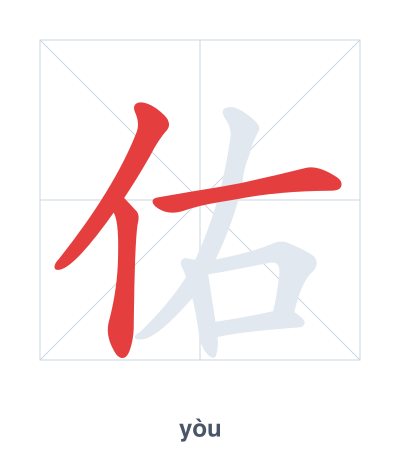
Open Hanzi Writer to see the animated stroke order and practice writing 佑 with real-time feedback.
The character 佑 (yòu) is written with 7 strokes. Follow the standard Chinese stroke order: top to bottom, left to right, outside before inside. The radical 亻 is one of its key components.
Practice the correct stroke order with the Hanzi Writer app to see animated stroke-by-stroke guidance with real-time feedback.
佑 means to bless; to protect.
As an HSK Level 7 character, 佑 is an intermediate-level character.
佑 combines the radical 亻 (person) with 右 (right side; to help). In ancient form, 右 depicted a hand (又) and a mouth (口), symbolizing offering help or guidance. Thus, 佑 literally means 'a person who helps from the right,' evolving into the sense of divine protection or blessing.
💡 Memory Tip: Imagine a guardian angel standing on your right (右) side, reaching out a hand to bless and protect you (亻).
上天保佑你。
shàng tiān bǎo yòu nǐ
May Heaven bless you.
父母佑护着孩子。
fù mǔ yòu hù zhe hái zi
Parents protect and watch over their children.
得到神灵的庇佑。
dé dào shén líng de bì yòu
To receive divine protection.
Open Hanzi Writer to see the animated stroke order and practice writing 佑 with real-time feedback.
✨ Animated stroke order · Handwriting recognition · HSK-graded practice · Free to use
佑 combines the radical 亻 (person) on the left with 右 (yòu, right) on the right. The person radical indicates that the action involves a human, while 右 suggests the idea of helping with one's right hand, together meaning 'to bless and protect.'