蚕 (cán) means "silkworm" in Chinese. It has 10 strokes with the radical 虫.
Rated 4.2/5 in difficulty (advanced).
Appears in 3+ common words including 蚕宝宝 (cán bǎo bǎo), 蚕丝 (cán sī), 蚕茧 (cán jiǎn).
Due to its 10 strokes, Hanzi Writer's error detection shows 蚕 requires focused practice — most learners need 10+ attempts for consistent accuracy.
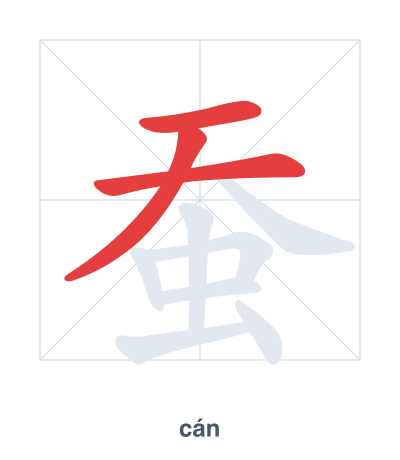
Open Hanzi Writer to see the animated stroke order and practice writing 蚕 with real-time feedback.
The character 蚕 (cán) is written with 10 strokes. Follow the standard Chinese stroke order: top to bottom, left to right, outside before inside. The radical 虫 is one of its key components.
Practice the correct stroke order with the Hanzi Writer app to see animated stroke-by-stroke guidance with real-time feedback.
蚕 means silkworm.
The simplified character 蚕 combines 天 (sky/heaven) on top with 虫 (insect) below, portraying the silkworm as a 'heavenly insect' because of its precious silk. Originally the traditional form 蠶 used 朁 as a phonetic component, but the simplified version visually suggests an insect that produces a sky-like gift of silk.
💡 Memory Tip: Picture a silkworm (虫) crawling under a vast sky (天) as it spins a shimmering silk thread that reaches up to the heavens.
蚕宝宝在吃桑叶。
cán bǎo bǎo zài chī sāng yè
The baby silkworms are eating mulberry leaves.
蚕丝可以做衣服。
cán sī kě yǐ zuò yī fú
Silk can be used to make clothes.
这是一个白色的蚕茧。
zhè shì yí gè bái sè de cán jiǎn
This is a white silkworm cocoon.
Open Hanzi Writer to see the animated stroke order and practice writing 蚕 with real-time feedback.
✨ Animated stroke order · Handwriting recognition · HSK-graded practice · Free to use
The character 蚕 is made of two parts: the top is 天 (tiān, sky) and the bottom is 虫 (chóng, insect). The bottom part tells you it is a type of insect, while the top part provides a phonetic hint (though the pronunciation is not exactly the same). Together they represent the silkworm, an insect that produces silk under the sky.