贻 (yí) means "Give; leave behind; cause" in Chinese. It has 9 strokes with the radical 贝.
Rated 4/5 in difficulty (challenging).
Appears in 3+ common words including 贻误 (yí wù), 贻笑 (yí xiào), 贻害 (yí hài).
Due to its 9 strokes, Hanzi Writer's error detection shows 贻 requires focused practice — most learners need 10+ attempts for consistent accuracy.
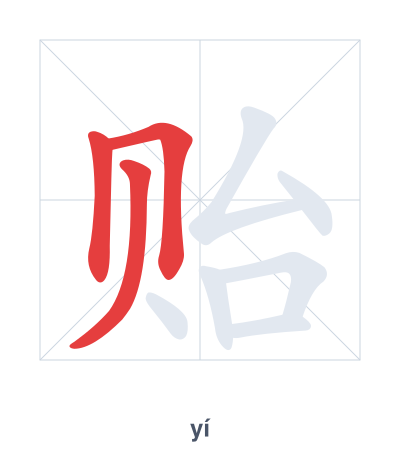
Open Hanzi Writer to see the animated stroke order and practice writing 贻 with real-time feedback.
The character 贻 (yí) is written with 9 strokes. Follow the standard Chinese stroke order: top to bottom, left to right, outside before inside. The radical 贝 is one of its key components.
Practice the correct stroke order with the Hanzi Writer app to see animated stroke-by-stroke guidance with real-time feedback.
贻 means Give; leave behind; cause.
贻 combines the radical 贝 (shell, representing wealth) with the phonetic component 台. The character originally referred to presenting gifts or bequeathing property, linking the concept of giving or leaving behind with valuable items.
💡 Memory Tip: Imagine giving a seashell (贝) as a gift to someone on a platform (台), leaving behind a happy memory.
不要贻误了工作。
bú yào yí wù le gōng zuò
Don't delay the work.
这件事让人贻笑。
zhè jiàn shì ràng rén yí xiào
This matter makes one a laughingstock.
这种做法贻害很大。
zhè zhǒng zuò fǎ yí hài hěn dà
This practice causes great harm.
Open Hanzi Writer to see the animated stroke order and practice writing 贻 with real-time feedback.
✨ Animated stroke order · Handwriting recognition · HSK-graded practice · Free to use
贻 is composed of the radical 贝 (shell, symbolizing money or valuables) on the left and the phonetic component 台 (yí) on the right. The 贝 radical suggests that the character involves exchange or transfer of value, which connects to its basic meaning of "give" or "leave behind." The phonetic part 台 hints at the pronunciation yí, but does not carry meaning.