蛜 (yī) means "woodlouse" in Chinese. It has 12 strokes with the radical 虫.
Rated 4.2/5 in difficulty (advanced).
Appears in 3+ common words including 蛜蝛 (yī wēi), 蛜虫 (yī chóng), 捉蛜 (zhuō yī).
Due to its 12 strokes, Hanzi Writer's error detection shows 蛜 requires focused practice — most learners need 10+ attempts for consistent accuracy.
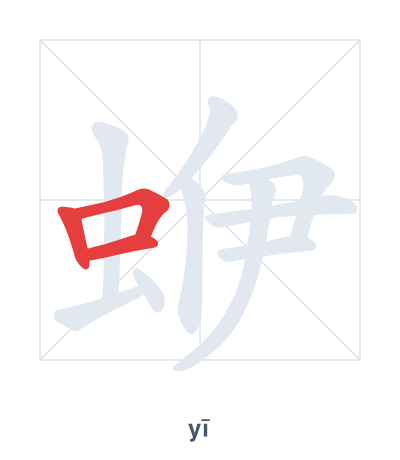
Open Hanzi Writer to see the animated stroke order and practice writing 蛜 with real-time feedback.
The character 蛜 (yī) is written with 12 strokes. Follow the standard Chinese stroke order: top to bottom, left to right, outside before inside. The radical 虫 is one of its key components.
Practice the correct stroke order with the Hanzi Writer app to see animated stroke-by-stroke guidance with real-time feedback.
蛜 means woodlouse.
蛜 is a phono-semantic compound: the radical 虫 ('insect, bug') indicates the meaning 'woodlouse', while the right side 伊 (yī) provides the pronunciation. This character is rarely used, appearing mainly in the ancient term 蛜蝛 (yī wēi) for woodlouse, where 蝛 is a rare character as well.
💡 Memory Tip: Imagine a woodlouse (虫) wearing a tiny '伊' name tag, reminding you it's called 'yī'.
这种虫子叫作蛜蝛。
zhè zhǒng chóng zi jiào zuò yī wēi
This insect is called a woodlouse.
蛜虫生活在潮湿的地方。
yī chóng shēng huó zài cháo shī de dì fāng
Woodlice live in damp places.
小孩子在石头下捉蛜。
xiǎo hái zi zài shí tou xià zhuō yī
The child is catching lizards under the rocks.
Open Hanzi Writer to see the animated stroke order and practice writing 蛜 with real-time feedback.
✨ Animated stroke order · Handwriting recognition · HSK-graded practice · Free to use
蛜 is composed of the radical 虫 (chóng, meaning insect or bug) on the left, and the phonetic component 伊 (yī) on the right. The radical 虫 indicates that the character refers to a type of small creature, specifically a woodlouse, while 伊 provides pronunciation hints.