殗 (yè) means "sickness; to be ill" in Chinese. It has 12 strokes with the radical 歹.
Rated 4.2/5 in difficulty (advanced).
Appears in 3+ common words including 殗殜 (yè dié), 殗殗 (yè yè), 殗病 (yè bìng).
Due to its 12 strokes, Hanzi Writer's error detection shows 殗 requires focused practice — most learners need 10+ attempts for consistent accuracy.
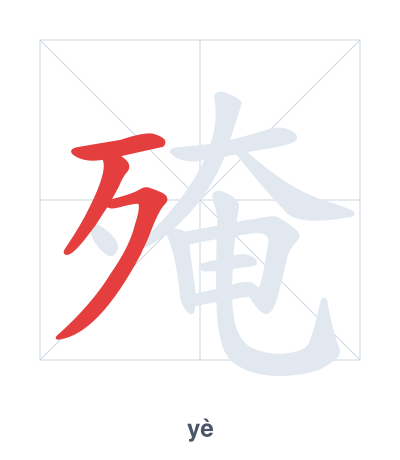
Open Hanzi Writer to see the animated stroke order and practice writing 殗 with real-time feedback.
The character 殗 (yè) is written with 12 strokes. Follow the standard Chinese stroke order: top to bottom, left to right, outside before inside. The radical 歹 is one of its key components.
Practice the correct stroke order with the Hanzi Writer app to see animated stroke-by-stroke guidance with real-time feedback.
殗 means sickness; to be ill.
| Character | 殗 |
| Pinyin | yè (ye) |
| Meaning | sickness; to be ill |
| Strokes | 12 |
| Radical | 歹 |
| Difficulty | 4.2/5 |
殗 combines the radical 歹 (death or decay) with 奄 (to cover), suggesting an illness that overwhelms or enshrouds a person. The component 奄 also gives the character its pronunciation yè, while the radical 歹 grounds it in the domain of mortality and disease.
💡 Memory Tip: Imagine a skeleton (歹) huddled under a heavy blanket (奄), too sick to move, with a thermometer in its mouth reading 'yè' (fever).
他病得殗殜。
tā bìng dé yè dié
He is bedridden with a lingering illness.
他的气息殗殗。
tā de qì xī yè yè
His breathing is very weak.
他因殗病卧床。
tā yīn yè bìng wò chuáng
He was bedridden due to a lingering illness.
Open Hanzi Writer to see the animated stroke order and practice writing 殗 with real-time feedback.
✨ Animated stroke order · Handwriting recognition · HSK-graded practice · Free to use
殗 is composed of the radical 歹 on the left, which means "death" or "danger," and the phonetic component 奄 on the right. The radical 歹 hints at illness or death, while 奄 (meaning "to cover" or "lingering") suggests a sick person lying under a cover. Together they convey the idea of being ill, especially with a lingering or slight sickness.