脓 (nóng) means "pus" in Chinese. It has 10 strokes with the radical 月.
Rated 4.2/5 in difficulty (advanced).
Appears in 3+ common words including 化脓 (huà nóng), 脓包 (nóng bāo), 流脓 (liú nóng).
Due to its 10 strokes, Hanzi Writer's error detection shows 脓 requires focused practice — most learners need 10+ attempts for consistent accuracy.
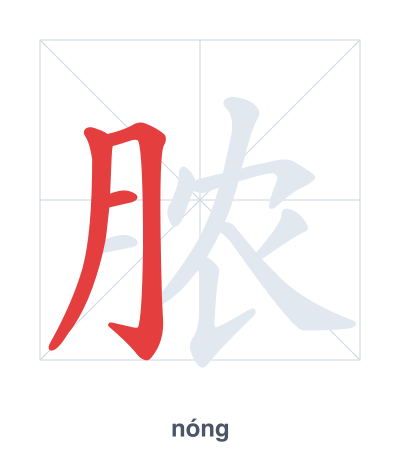
Open Hanzi Writer to see the animated stroke order and practice writing 脓 with real-time feedback.
The character 脓 (nóng) is written with 10 strokes. Follow the standard Chinese stroke order: top to bottom, left to right, outside before inside. The radical 月 is one of its key components.
Practice the correct stroke order with the Hanzi Writer app to see animated stroke-by-stroke guidance with real-time feedback.
脓 means pus.
脓 combines the flesh radical 月 (body part) with the phonetic component 农 (nóng, meaning farmer or farming). The character depicts infected bodily fluid, as a farmer's wound might fester and produce pus.
💡 Memory Tip: A farmer's (农) flesh (月) wound oozes thick yellow pus.
伤口化脓了。
shāng kǒu huà nóng le
The wound has become infected and is festering.
他手上长了个脓包。
tā shǒu shàng zhǎng le gè nóng bāo
He has a pustule on his hand.
他的耳朵在流脓。
tā de ěr duǒ zài liú nóng
His ear is oozing pus.
Open Hanzi Writer to see the animated stroke order and practice writing 脓 with real-time feedback.
✨ Animated stroke order · Handwriting recognition · HSK-graded practice · Free to use
The left side is the radical 月 (月字旁), which is a form of 肉 (flesh/body part) indicating the character relates to the body. The right side is 农 (nóng, farmer/agriculture), which gives the sound. Together, 脓 means pus, a bodily fluid from infection.