藇 (xù) means "Beautiful / Fine" in Chinese. It has 17 strokes with the radical 艹.
Rated 4.2/5 in difficulty (advanced).
Appears in 3+ common words including 藇藇 (xù xù), 嘉藇 (jiā xù), 藇美 (xù měi).
Due to its 17 strokes, Hanzi Writer's error detection shows 藇 requires focused practice — most learners need 10+ attempts for consistent accuracy.
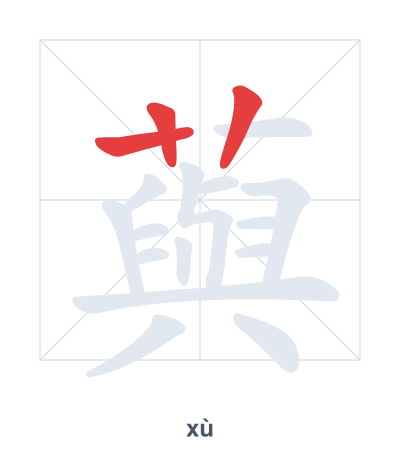
Open Hanzi Writer to see the animated stroke order and practice writing 藇 with real-time feedback.
The character 藇 (xù) is written with 17 strokes. Follow the standard Chinese stroke order: top to bottom, left to right, outside before inside. The radical 艹 is one of its key components.
Practice the correct stroke order with the Hanzi Writer app to see animated stroke-by-stroke guidance with real-time feedback.
藇 means Beautiful / Fine.
藇 is a phono-semantic compound combining the grass radical 艹 with 與, which provides the phonetic element and adds the idea of 'giving' or 'together'. It originally referred to fine, beautiful grass, and later extended to mean 'beautiful' or 'fine' in general, especially in describing wine.
💡 Memory Tip: Picture a lush patch of grass (艹) so beautiful that you give it as a gift (與) to someone special.
微风藇藇地吹过。
wēi fēng xù xù dì chuī guò
The breeze blew gently.
他展现了嘉藇的才华。
tā zhǎn xiàn le jiā xù de cái huá
He displayed outstanding talent.
这篇文章辞藻藇美。
zhè piān wén zhāng cí zǎo xù měi
The language of this article is beautiful and ornate.
Open Hanzi Writer to see the animated stroke order and practice writing 藇 with real-time feedback.
✨ Animated stroke order · Handwriting recognition · HSK-graded practice · Free to use
藇 is made of the grass radical 艹 on top and 與 (yǔ) below. The grass radical suggests a connection to plants or nature, while 與 provides the pronunciation. Together they create the meaning "beautiful" or "fine," often describing elegant plants or refined things.