诩 (xǔ) means "to boast" in Chinese. It has 8 strokes with the radical 讠.
Rated 3.4/5 in difficulty (challenging).
Appears in 3+ common words including 自诩 (zì xǔ), 夸诩 (kuā xǔ), 诩 (xǔ).
Due to its 8 strokes, Hanzi Writer's error detection shows 诩 requires focused practice — most learners need 10+ attempts for consistent accuracy.
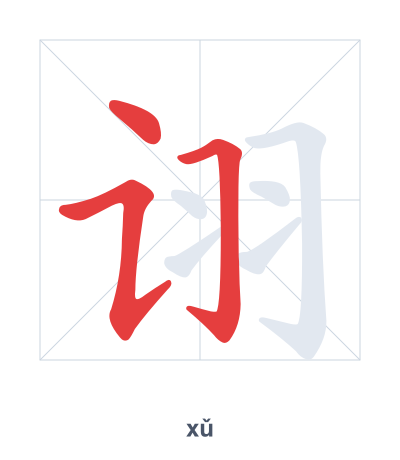
Open Hanzi Writer to see the animated stroke order and practice writing 诩 with real-time feedback.
The character 诩 (xǔ) is written with 8 strokes. Follow the standard Chinese stroke order: top to bottom, left to right, outside before inside. The radical 讠 is one of its key components.
Practice the correct stroke order with the Hanzi Writer app to see animated stroke-by-stroke guidance with real-time feedback.
诩 means to boast.
诩 is a compound character combining the radical 讠 (speech) with 羽 (feather). The visual suggests 'boasting' as speaking in a way that is showy or flamboyant, like a bird displaying its feathers.
💡 Memory Tip: Picture a peacock (羽) opening its mouth (讠) to boast about its beautiful feathers.
他自诩为天才。
tā zì xǔ wèi tiān cái
He boasted of being a genius.
不要到处夸诩自己。
bú yào dào chù kuā xǔ zì jǐ
Don't brag about yourself everywhere.
他以此自诩。
tā yǐ cǐ zì xǔ
He prides himself on this.
Open Hanzi Writer to see the animated stroke order and practice writing 诩 with real-time feedback.
✨ Animated stroke order · Handwriting recognition · HSK-graded practice · Free to use
诩 is composed of the radical 讠 (speech) on the left and the character 羽 (feather or wing) on the right. The speech radical hints that the character is about words, while 羽 suggests something light or fluttering, like boastful words that fly away quickly. Together they create the meaning 'to boast' or 'to brag'.