鸺 (xiū) means "owlet" in Chinese. It has 11 strokes with the radical 鸟.
Rated 4.2/5 in difficulty (advanced).
Appears in 3+ common words including 鸺鹠 (xiū liú), 小鸺鹠 (xiǎo xiū liú), 鸺鹠鸣 (xiū liú míng).
Due to its 11 strokes, Hanzi Writer's error detection shows 鸺 requires focused practice — most learners need 10+ attempts for consistent accuracy.
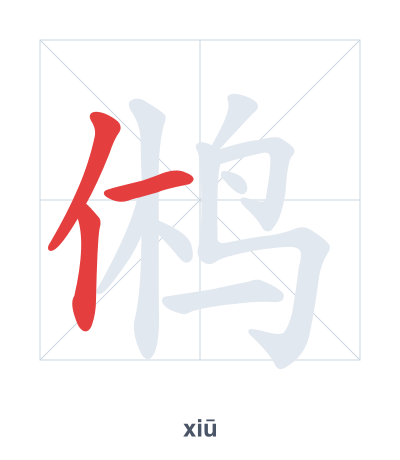
Open Hanzi Writer to see the animated stroke order and practice writing 鸺 with real-time feedback.
The character 鸺 (xiū) is written with 11 strokes. Follow the standard Chinese stroke order: top to bottom, left to right, outside before inside. The radical 鸟 is one of its key components.
Practice the correct stroke order with the Hanzi Writer app to see animated stroke-by-stroke guidance with real-time feedback.
鸺 means owlet.
鸺 is a phono-semantic compound combining the radical 鸟 (bird) with 休 (xiū, 'rest') as a phonetic component. The character denotes an owlet, a small nocturnal owl that rests during the day, linking the idea of 'resting bird' to its meaning.
💡 Memory Tip: Imagine a person (休, leaning against a tree) resting while a tiny owl (鸟) perches silently above, blending into the night.
鸺鹠是小猫头鹰。
xiū liú shì xiǎo māo tóu yīng
The owlet is a small owl.
这只小鸺鹠很可爱。
zhè zhǐ xiǎo xiū liú hěn kě ài
This little owlet is very cute.
夜里听见鸺鹠鸣。
yè lǐ tīng jiàn xiū liú míng
The hooting of an owl is heard at night.
Open Hanzi Writer to see the animated stroke order and practice writing 鸺 with real-time feedback.
✨ Animated stroke order · Handwriting recognition · HSK-graded practice · Free to use
鸺 is composed of the radical 鸟 (bird) on the right and the phonetic component 休 (xiū, meaning rest) on the left. The bird radical indicates it is a type of bird, while the sound comes from 休. Together, they form the word for an owlet, a small owl-like bird.