荥 (xíng) means "Xing (place name character)" in Chinese. It has 9 strokes with the radical 艹.
Rated 4/5 in difficulty (challenging).
Appears in 3+ common words including 荥阳 (xíng yáng), 荥经 (xíng jīng), 荥穴 (xíng xué).
Due to its 9 strokes, Hanzi Writer's error detection shows 荥 requires focused practice — most learners need 10+ attempts for consistent accuracy.
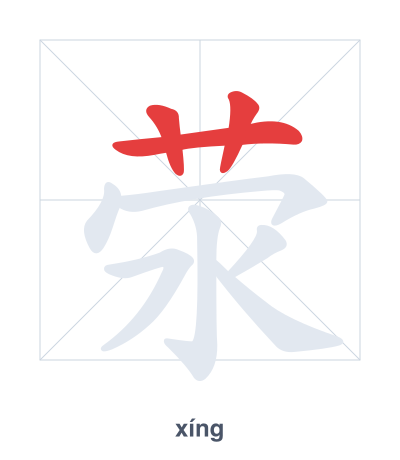
Open Hanzi Writer to see the animated stroke order and practice writing 荥 with real-time feedback.
The character 荥 (xíng) is written with 9 strokes. Follow the standard Chinese stroke order: top to bottom, left to right, outside before inside. The radical 艹 is one of its key components.
Practice the correct stroke order with the Hanzi Writer app to see animated stroke-by-stroke guidance with real-time feedback.
荥 means Xing (place name character).
Originally written as 滎, combining water (氵) and 荧 (glimmer), referring to a place where water shimmered. The simplified form 荥 replaces the water radical with the grass radical (艹), suggesting a location with lush vegetation. The lower part 荧 still hints at the original glimmering quality.
💡 Memory Tip: Picture a grassy field (艹) where a small fire (火) flickers under a roof (冖) – that's the place Xing.
荥阳是一个古老的城市。
xíng yáng shì yí gè gǔ lǎo de chéng shì
Xingyang is an ancient city.
荥经县在四川省。
xíng jīng xiàn zài sì chuān shěng
Yingjing County is in Sichuan Province.
这是中医里的荥穴。
zhè shì zhōng yī lǐ de xíng xué
This is a Ying-spring point in Chinese medicine.
Open Hanzi Writer to see the animated stroke order and practice writing 荥 with real-time feedback.
✨ Animated stroke order · Handwriting recognition · HSK-graded practice · Free to use
荥 is composed of the radical 艹 (grass) on top and the phonetic component 荧 (yíng) below. The grass radical hints that the character is often used in place names with natural features, but the meaning of 'Xing' as a place name is not directly tied to grass. Its structure primarily serves as a phonetic-semantic compound for geographical names.