潟 (xì) means "lagoon; salt flat" in Chinese. It has 15 strokes with the radical 氵.
Rated 4.2/5 in difficulty (advanced).
Appears in 3+ common words including 潟湖 (xì hú), 盐潟 (yán xì), 潟地 (xì dì).
Due to its 15 strokes, Hanzi Writer's error detection shows 潟 requires focused practice — most learners need 10+ attempts for consistent accuracy.
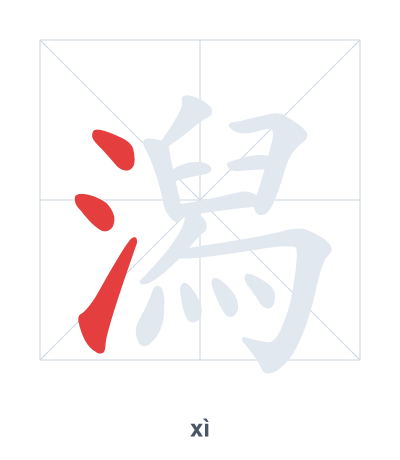
Open Hanzi Writer to see the animated stroke order and practice writing 潟 with real-time feedback.
The character 潟 (xì) is written with 15 strokes. Follow the standard Chinese stroke order: top to bottom, left to right, outside before inside. The radical 氵 is one of its key components.
Practice the correct stroke order with the Hanzi Writer app to see animated stroke-by-stroke guidance with real-time feedback.
潟 means lagoon; salt flat.
潟 combines the water radical 氵 with 舄, an ancient pictograph of a shoe or footprint that came to represent a flat, salty area. Together, they depict water covering a salt flat or lagoon, emphasizing the shallow, saline nature of the landscape.
💡 Memory Tip: Picture a shoe (舄) left behind on a salt flat, slowly filling with water (氵) to form a small lagoon.
这个潟湖非常大。
zhè ge xì hú fēi cháng dà
This lagoon is very large.
海边有很多盐潟。
hǎi biān yǒu hěn duō yán xì
There are many salt lagoons by the seaside.
这里是一片潟地。
zhè lǐ shì yī piàn xì dì
This is a lagoon.
Open Hanzi Writer to see the animated stroke order and practice writing 潟 with real-time feedback.
✨ Animated stroke order · Handwriting recognition · HSK-graded practice · Free to use
潟 is made of the water radical 氵 on the left and 舃 (xì, a phonetic component) on the right. The water radical connects to its meanings like lagoon or salt flat, which are related to water or wet salt lands. The right part 舃 hints at the pronunciation but not the meaning.