绾 (wǎn) means "to tie up (hair); to bind" in Chinese. It has 11 strokes with the radical 纟.
Rated 4.2/5 in difficulty (advanced).
Appears in 3+ common words including 绾起 (wǎn qǐ), 绾发 (wǎn fā), 绾结 (wǎn jié).
Due to its 11 strokes, Hanzi Writer's error detection shows 绾 requires focused practice — most learners need 10+ attempts for consistent accuracy.
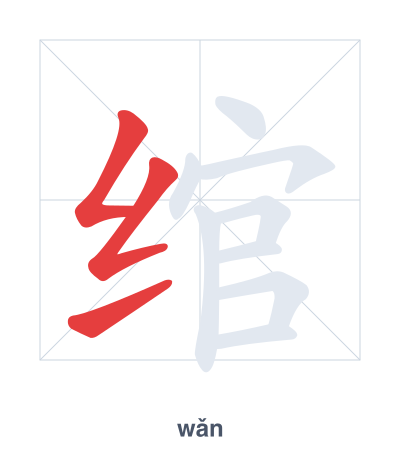
Open Hanzi Writer to see the animated stroke order and practice writing 绾 with real-time feedback.
The character 绾 (wǎn) is written with 11 strokes. Follow the standard Chinese stroke order: top to bottom, left to right, outside before inside. The radical 纟 is one of its key components.
Practice the correct stroke order with the Hanzi Writer app to see animated stroke-by-stroke guidance with real-time feedback.
绾 means to tie up (hair); to bind.
绾 combines the silk radical 纟 (thread) with 官 (official), which provides the sound. The silk thread visually represents binding or tying, so the character means to tie up hair or bind something.
💡 Memory Tip: Imagine an official (官) using a silk ribbon (纟) to neatly tie up their long hair into a bun.
她把长发绾了起来。
tā bǎ cháng fà wǎn le qǐ lái
She coiled her long hair up.
她正在镜前绾发。
tā zhèng zài jìng qián wǎn fā
She is doing her hair in front of the mirror.
他在绳子上绾了个结。
tā zài shéng zi shàng wǎn le gè jié
He tied a knot in the rope.
Open Hanzi Writer to see the animated stroke order and practice writing 绾 with real-time feedback.
✨ Animated stroke order · Handwriting recognition · HSK-graded practice · Free to use
绾 combines the radical 纟 (silk) on the left, which relates to threads or binding, with the phonetic component 官 (guān). Together, they suggest using a silk-like material to bind or tie something, specifically hair.