腽 (wà) means "fat / fur seal" in Chinese. It has 13 strokes with the radical 月.
Rated 4.2/5 in difficulty (advanced).
Appears in 3+ common words including 腽肭 (wà nà), 腽肭兽 (wà nà shòu), 腽肭脐 (wà nà qí).
Due to its 13 strokes, Hanzi Writer's error detection shows 腽 requires focused practice — most learners need 10+ attempts for consistent accuracy.
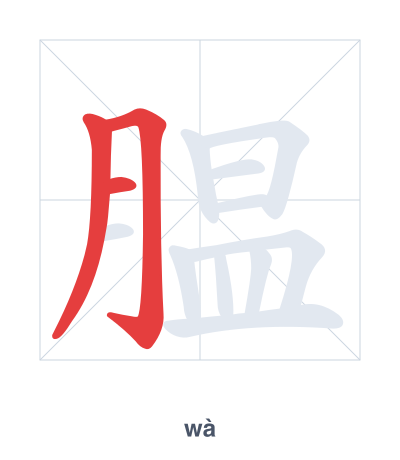
Open Hanzi Writer to see the animated stroke order and practice writing 腽 with real-time feedback.
The character 腽 (wà) is written with 13 strokes. Follow the standard Chinese stroke order: top to bottom, left to right, outside before inside. The radical 月 is one of its key components.
Practice the correct stroke order with the Hanzi Writer app to see animated stroke-by-stroke guidance with real-time feedback.
腽 means fat / fur seal.
腽 is a phono-semantic compound: the radical 月 (meat/flesh) indicates it relates to animal fat or body tissue, while 屋 (wū, meaning 'house') supplies the pronunciation. The character is used in the term 腽肭 (wànà), referring to the fat of fur seals or the animal itself, likely a transliteration from a foreign word.
💡 Memory Tip: Imagine a fat fur seal (月) so large it fills an entire house (屋), squishing against the walls with its blubber.
腽肭生活在海里。
wà nà shēng huó zài hǎi lǐ
Fur seals live in the sea.
腽肭兽很可爱。
wà nà shòu hěn kě ài
Fur seals are very cute.
这是腽肭脐。
zhè shì wà nà qí
This is a fur seal's penis (used in traditional medicine).
Open Hanzi Writer to see the animated stroke order and practice writing 腽 with real-time feedback.
✨ Animated stroke order · Handwriting recognition · HSK-graded practice · Free to use
腽 is made of the radical 月 (meat/flesh) on the left and the component 屋 (wū, meaning house) on the right. The 月 radical shows that the character relates to body parts or fat, while 屋 provides the pronunciation hint. Together they form a phonetic compound used for 'fat' and the animal 'fur seal'.