鸵 (tuó) means "ostrich" in Chinese. It has 10 strokes with the radical 鸟.
Rated 4.2/5 in difficulty (advanced).
Appears in 3+ common words including 鸵鸟 (tuó niǎo), 鸵鸟蛋 (tuó niǎo dàn), 鸵鸟肉 (tuó niǎo ròu).
Due to its 10 strokes, Hanzi Writer's error detection shows 鸵 requires focused practice — most learners need 10+ attempts for consistent accuracy.
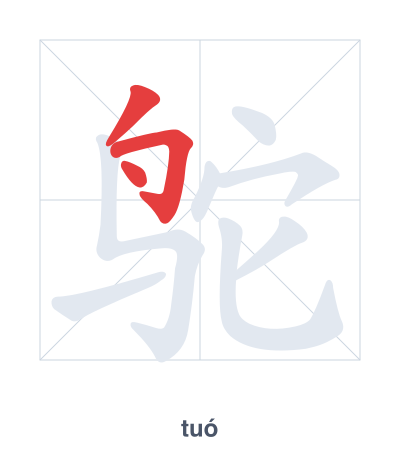
Open Hanzi Writer to see the animated stroke order and practice writing 鸵 with real-time feedback.
The character 鸵 (tuó) is written with 10 strokes. Follow the standard Chinese stroke order: top to bottom, left to right, outside before inside. The radical 鸟 is one of its key components.
Practice the correct stroke order with the Hanzi Writer app to see animated stroke-by-stroke guidance with real-time feedback.
鸵 means ostrich.
鸵 is a phono-semantic compound: the radical 鸟 (bird) indicates the meaning relates to birds, while 它 (tuó) provides the approximate pronunciation. The character was created to name the ostrich, a large flightless bird native to Africa.
💡 Memory Tip: Imagine an ostrich stepping on your TOE (它 sounds like 'toe') with its powerful claw, and the 鸟 radical reminds you it's a bird.
鸵鸟跑得非常快。
tuó niǎo pǎo dé fēi cháng kuài
Ostriches run very fast.
鸵鸟蛋很大。
tuó niǎo dàn hěn dà
Ostrich eggs are very large.
你吃过鸵鸟肉吗?
nǐ chī guò tuó niǎo ròu ma
Have you ever eaten ostrich meat?
Open Hanzi Writer to see the animated stroke order and practice writing 鸵 with real-time feedback.
✨ Animated stroke order · Handwriting recognition · HSK-graded practice · Free to use
鸵 is made of two parts: the left radical 马 (horse) and the right component 它 (ta, meaning 'it'). However, the meaning 'ostrich' comes from the radical 鸟 (bird) on the right side in the traditional form or from the overall context, as ostriches are large birds. The left 马 hints at the ostrich's long legs and speed, similar to a horse.