煺 (tuì) means "to pluck; to remove hair or skin using hot water" in Chinese. It has 13 strokes with the radical 火.
Rated 4.2/5 in difficulty (advanced).
Appears in 3+ common words including 煺毛 (tuì máo), 煺掉 (tuì diào), 煺皮 (tuì pí).
Due to its 13 strokes, Hanzi Writer's error detection shows 煺 requires focused practice — most learners need 10+ attempts for consistent accuracy.
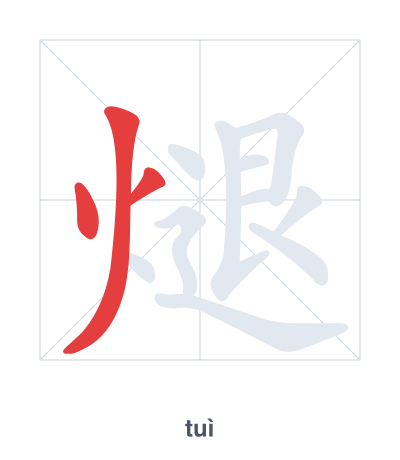
Open Hanzi Writer to see the animated stroke order and practice writing 煺 with real-time feedback.
The character 煺 (tuì) is written with 13 strokes. Follow the standard Chinese stroke order: top to bottom, left to right, outside before inside. The radical 火 is one of its key components.
Practice the correct stroke order with the Hanzi Writer app to see animated stroke-by-stroke guidance with real-time feedback.
煺 means to pluck; to remove hair or skin using hot water.
煺 combines 火 (fire/heat) with 退 (retreat), indicating that heat from hot water makes hair or skin 'retreat' so it can be removed. The 火 radical directly points to the scalding process, while 退 supplies the sound and the idea of withdrawal.
💡 Memory Tip: Picture a pig's hairy skin being dipped in boiling water (火) as the hair retreats (退) and is then plucked off with ease.
杀鸡要先煺毛。
shā jī yào xiān tuì máo
To slaughter a chicken, you must first remove the feathers.
把猪皮上的毛煺掉。
bǎ zhū pí shàng de máo tuì diào
Scald the hair off the pigskin.
这种鱼不需要煺皮。
zhè zhǒng yú bù xū yào tuì pí
This kind of fish does not need to be skinned.
Open Hanzi Writer to see the animated stroke order and practice writing 煺 with real-time feedback.
✨ Animated stroke order · Handwriting recognition · HSK-graded practice · Free to use
The character 煺 combines the radical 火 (fire) on the left and 退 (tuì, to retreat) on the right. Fire represents the use of hot water for the plucking process, while 退 gives the pronunciation and hints at the idea of removing or making something retreat (such as feathers or skin).