湍 (tuān) means "Rapid or rushing water" in Chinese. It has 12 strokes with the radical 氵.
Rated 4.2/5 in difficulty (advanced).
Appears in 3+ common words including 湍急 (tuān jí), 湍流 (tuān liú), 急湍 (jí tuān).
Due to its 12 strokes, Hanzi Writer's error detection shows 湍 requires focused practice — most learners need 10+ attempts for consistent accuracy.
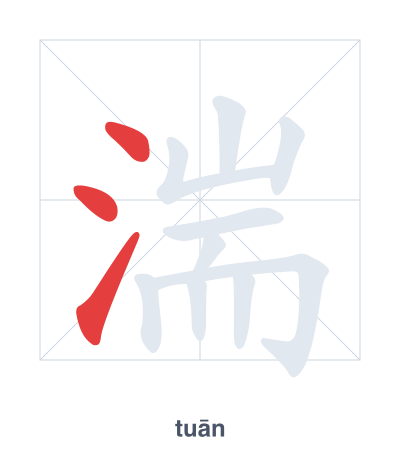
Open Hanzi Writer to see the animated stroke order and practice writing 湍 with real-time feedback.
The character 湍 (tuān) is written with 12 strokes. Follow the standard Chinese stroke order: top to bottom, left to right, outside before inside. The radical 氵 is one of its key components.
Practice the correct stroke order with the Hanzi Writer app to see animated stroke-by-stroke guidance with real-time feedback.
湍 means Rapid or rushing water.
湍 combines the water radical 氵 with 耑, which originally depicted a plant sprouting from the ground and carried the sense of 'tip' or 'beginning.' Here, 耑 acts as a phonetic element while also suggesting water rushing forward like a sprout shooting upward, creating the idea of fast, urgent flow.
💡 Memory Tip: Picture a river (氵) with a sharp, speeding arrow (耑) cutting through it, making the waters churn into a rapid torrent.
河水非常湍急。
hé shuǐ fēi cháng tuān jí
The river water is very turbulent.
水中有很多湍流。
shuǐ zhōng yǒu hěn duō tuān liú
There are many rapids in the water.
这里有急湍。
zhè lǐ yǒu jí tuān
There are rapid currents here.
Open Hanzi Writer to see the animated stroke order and practice writing 湍 with real-time feedback.
✨ Animated stroke order · Handwriting recognition · HSK-graded practice · Free to use
The left part is the water radical 氵, which shows the character relates to water. The right part is 耑 (duān), which originally means "end" or "tip," and together they suggest water rushing to a point — like a rapid current or torrent.